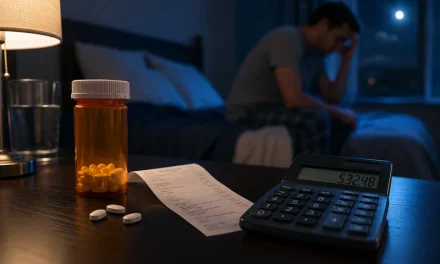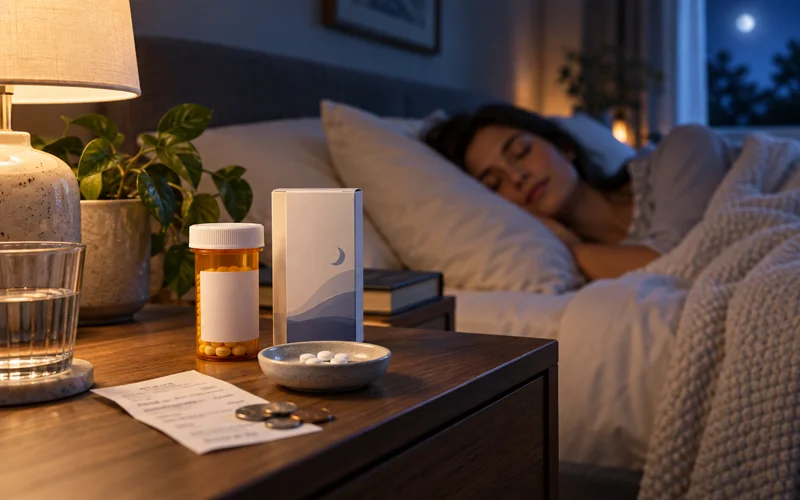
You picked up a new prescription for doxepin to help with sleep, and now you are staring at two very different numbers depending on which pharmacy you called. That is not a mistake. Doxepin exists as two genuinely different products at the pharmacy counter, an old, inexpensive generic antidepressant and a specifically approved low-dose insomnia brand called Silenor, and the price gap between them is one of the largest you will find for a single active ingredient. This guide walks through both paths so you know which one applies to you before you pay.

Quick Answer
Compare pharmacy prices near you before you fill either version. As a general range: generic doxepin capsules typically run $13 to $30 for a 30-day supply without insurance, sometimes far less with a discount card, while brand-name Silenor commonly runs $400 to $550 or more for the same length of treatment. Which number applies to you depends entirely on which product is written on your prescription, which is what the rest of this guide walks through.
Step 1: Find Out Which Doxepin You Were Actually Prescribed
Before worrying about price, confirm with your prescriber or pharmacist which of the two products your prescription is for. This single detail determines almost everything else about your cost.
Path A: Standard Generic Doxepin Capsules
Doxepin was originally developed and FDA-approved as an antidepressant, prescribed at higher doses (75 mg to 300 mg per day) for depression and anxiety. Many prescribers write for a low-strength generic capsule off-label at bedtime specifically to use its sedating side effect for sleep. If your prescription is for a standard generic capsule strength, even a low one, you are almost certainly on this lower-cost path.
Path B: Brand-Name Silenor
Silenor is the only FDA-approved product built specifically around the ultra-low 3 mg and 6 mg doxepin doses studied for insomnia characterized by difficulty staying asleep. Standard generic doxepin capsules are not manufactured at these exact ultra-low strengths, so if your prescriber wants that precise, approved dosing, they may write for Silenor by name. If your prescription bottle or pharmacy receipt says “Silenor,” you are on the higher-cost brand path.
Step 2: Know the Real Cost of Each Path
| Doxepin Option | Estimated Cost for a 30-Day Supply |
| Generic doxepin capsules, low dose (such as 10 mg), retail cash price | Roughly $13 to $30 |
| Generic doxepin, with a pharmacy discount card | Often $2 to $10 |
| Brand-name Silenor (3 mg or 6 mg tablets), retail cash price | Frequently $400 to $550 or more |
A manufacturer copay assistance program that once brought Silenor’s price down for eligible patients is no longer available, which means most patients without strong insurance coverage face the full brand price if Silenor is specifically prescribed rather than a generic alternative.
Step 3: Ask Whether You Can Switch Paths
If you were prescribed Silenor and the price surprised you, it is worth asking your prescriber a direct question: is an off-label, low-dose regimen using a standard generic capsule strength, taken as directed, a reasonable and less expensive alternative for your situation? Not every patient is a candidate for that switch, since Silenor’s approved dosing is more precise than what a standard generic capsule can replicate, but many prescribers are open to the conversation once cost becomes a barrier to actually taking the medication.
Why the Price Gap Is So Large

Silenor is the only FDA-approved product built around the 3 mg and 6 mg insomnia-specific doses, so as a single-source brand it is priced far above the decades-old generic antidepressant version of the same active ingredient. Generic doxepin, by contrast, has been manufactured by multiple companies for years, and ordinary market competition keeps its price low. This is the same dynamic seen across many drug categories: a specific, approved low-dose formulation of an old drug often costs dramatically more than the standard generic version of the identical molecule.
Insurance Coverage: What to Expect on Each Path
Generic doxepin at standard antidepressant doses is typically covered by commercial insurance, Medicare Part D, and Medicaid with minimal restrictions, similar to trazodone, since it is inexpensive and not a controlled substance. Silenor, by contrast, often requires prior authorization, and many insurers require documentation that the patient has already tried a lower-cost generic alternative before approving coverage for the brand.
For a broader look at why some sleep medications face more insurance restrictions than others, see why sleep medications are rarely covered long-term by insurance. If your doctor believes Silenor’s specific low-dose formulation is medically necessary for you, ask them to include that reasoning directly in a prior authorization request, since insurers frequently deny the brand by default when a generic alternative theoretically exists.
What Actually Moves Your Price

- Which product is prescribed. This is by far the biggest factor, more than any pharmacy or discount.
- Dose strength. Higher-dose generic capsules used for depression are priced differently than the same drug at lower strengths.
- Pharmacy choice. As with most generics, cash prices for generic doxepin vary from one pharmacy to another.
- Insurance formulary tier. Silenor is frequently placed on a higher, non-preferred tier, while generic doxepin is usually on the lowest generic tier.
NuLifeSpan Rx vs. the Discontinued Silenor Copay Card
Since Silenor’s manufacturer copay card is no longer available, a NuLifeSpan Rx discount card is one of the few remaining ways to reduce your out-of-pocket cost at the pharmacy without an insurance-based prior authorization. It will not close the full gap between Silenor’s brand price and generic doxepin, but it can meaningfully lower the cash price on generic doxepin itself, which is usually the more practical fix for most patients rather than waiting on a manufacturer program that no longer exists.
A free prescription discount card can often reduce the cash price of generic doxepin significantly below standard retail pricing, and costs nothing to try. Discount cards generally provide little to no meaningful savings on single-source brand products like Silenor, so if cost is a major concern, discuss with your doctor whether generic doxepin is a clinically appropriate substitute before assuming a discount card will make Silenor affordable.

Important Limitations
Prices in this article are general estimates based on published 2026 sources and can vary by pharmacy, region, dose, and insurance status. Doxepin, including low-dose formulations, can interact with other medications and is not appropriate for everyone. This article is educational and is not medical advice. Talk with your doctor or pharmacist about which form of doxepin, if any, is appropriate for you, and about the risks and benefits of long-term use of any sleep medication.
Check Your Path Before You Pay
Whether you have been prescribed generic doxepin or brand-name Silenor, compare prescription prices at pharmacies near you with a free NuLifeSpan Rx discount card, and talk with your doctor about whether a generic option could meet your needs at a fraction of the brand-name cost.
Frequently Asked Questions
Is generic doxepin much cheaper than Silenor?
Yes. Generic doxepin capsules typically cost $13 to $30 for a 30-day supply without insurance, sometimes less with a discount card, while brand-name Silenor often costs $400 to $550 or more for the same length of treatment.
Why would a doctor prescribe Silenor instead of generic doxepin?
Silenor is specifically FDA-approved and manufactured at the very low 3 mg and 6 mg doses studied for insomnia. Standard generic doxepin capsules are not made at those exact ultra-low strengths, so some prescribers choose Silenor for precise, approved dosing, while others use off-label strategies with generic capsules.
Does insurance cover doxepin for sleep?
Generic doxepin is typically well covered by commercial insurance, Medicare, and Medicaid with few restrictions. Silenor often requires prior authorization and documentation that a generic alternative was tried first.
Is there a copay card for Silenor?
A manufacturer copay assistance program previously offered savings on Silenor, but it is no longer available as of recent years. Confirm current program availability directly with the manufacturer before assuming a discount applies.
Can I ask my doctor to prescribe generic doxepin instead of Silenor?
Yes, this is a reasonable question to raise with your prescriber, who can advise whether a generic, off-label low-dose approach is appropriate for your specific sleep concerns compared to the FDA-approved Silenor dosing.
Is doxepin a controlled substance?
No. Doxepin is not a controlled substance, which generally means fewer quantity limits and prior authorization hurdles compared to prescription hypnotics like zolpidem or benzodiazepines, at least for the generic version.