

You can often lower your monthly prescription costs by comparing generic alternatives, checking prices across pharmacies and payment methods, reviewing your insurance formulary, considering a 90-day supply, and exploring manufacturer or patient assistance programs. No single method works for every medication or every insurance plan, and some options only apply to specific drugs or circumstances. The methods below are practical starting points, not guarantees, and any change to what, how much, or how you take a medication should be made with your prescriber and pharmacist, not on your own.
Prescription prices are shaped by several factors working together: your deductible status, your plan’s copay structure, which pharmacy network you use, your plan’s drug formulary, the quantity and strength prescribed, the specific manufacturer, and even your location. The ten methods below address these factors from different angles, and using more than one together often works better than relying on just one.
1. Ask About FDA-Approved Generic Alternatives
Generic medications contain the same active ingredient as their brand-name counterparts and are approved by the FDA as therapeutically equivalent. According to MedlinePlus, switching from a brand-name medicine to its generic version is one of the most reliable ways to reduce a prescription’s cost, since brand-name prices reflect research and marketing costs that generics do not carry. The FTC’s consumer guidance on generic drugs cites FDA estimates that generics typically cost 80 to 85 percent less than their brand-name equivalents, though the actual difference for any specific medication depends on that drug’s own pricing and generic competition, and this figure is an estimate across many drugs rather than a promise for any one prescription. Not every medication has a generic version available yet, and not every generic is appropriate for every patient, so ask your prescriber or pharmacist whether an FDA-approved generic exists and is suitable for your specific situation before assuming one does.
2. Compare Prices at Multiple Pharmacies
The same medication can cost meaningfully different amounts at different pharmacies, even within a few miles of each other, because each pharmacy negotiates its own acquisition costs and sets its own markup. Comparing your cheapest available option across nearby pharmacies for the exact same medication, strength, and quantity takes only a few minutes and can reveal a meaningful price difference for the identical product. This applies whether you are paying cash, using insurance, or using a discount card, since each pricing path can vary independently by pharmacy.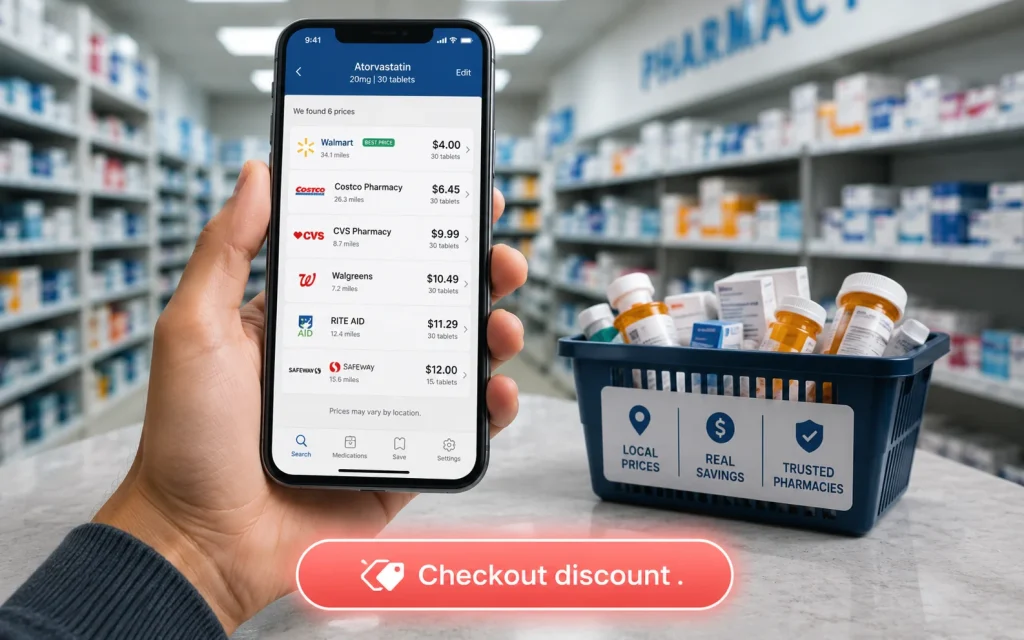
3. Compare Insurance Copays With Cash and Discount-Card Prices
Your insurance copay, the pharmacy’s cash price, and a discount-card price are three separate numbers, and the lowest one is not always the one you would assume. A prescription discount card is not insurance, and it generally cannot be combined with insurance on the same fill, but comparing all three options for your specific medication before you pay can sometimes reveal that a cash or discount-card price is lower than your copay, particularly for low-cost generics or before you have met your deductible. It is important to understand that paying cash or using a discount card instead of your insurance typically does not count toward your plan’s deductible or annual out-of-pocket maximum, since that tracking is based on claims processed through insurance. If meeting your deductible matters for your overall costs this year, weigh that before choosing to pay outside your insurance.
4. Review Your Insurance Formulary for Preferred Medications
Your plan’s formulary groups covered drugs into cost tiers, and medications in a preferred or lower tier generally cost less than those in a higher, non-preferred tier, even when both treat the same condition. Formulary tiers typically range from preferred generics at the lowest cost-sharing level up through non-preferred brand and specialty medications at the highest, and where your specific drug falls is a decision made by your plan, not by the drug’s actual clinical value relative to alternatives. Reviewing your formulary, or asking your insurer directly, to see whether a preferred alternative exists within the same drug class as your current prescription is worth doing periodically, sinc
e formularies change from year to year and a drug that was preferred last year may not be this year. Insurers are generally required to provide some notice before removing a drug from the formulary or increasing its cost-sharing tier, though the specific notice requirements vary by plan type and state. Any switch to a different medication within a drug class should be discussed with your prescriber first, since therapeutic alternatives are not automatically interchangeable for every patient.
5. Ask About 90-Day Prescription Supplies

For stable, long-term maintenance medications, a 90-day supply can sometimes lower your cost per dose compared with three separate 30-day fills, mainly because som
e insurance plans set a 90-day copay at less than three times the 30-day amount. This is not guaranteed for every plan or medication, and some prescriptions, including new prescriptions, controlled substances, and medications still being adjusted, are not good candidates for an extended supply. Ask your prescriber whether your specific medication is appropriate for a 90-day fill, and compare the actual total price for both options before assuming the larger quantity is cheaper.
6. Check Manufacturer Savings and Patient Assistance Programs
Many drug manufacturers offer copay cards for commercially insured patients or patient assistance programs for uninsured and underinsured patients who meet income and other eligibility criteria. These are generally two distinct types of support: a copay card typically reduces what a commercially insured patient owes at the pharmacy counter for a specific brand medication, while a patient assistance program more often provides the medication itself at no or reduced cost to patients who qualify based on income and insurance status. These programs are run independently by each manufacturer or by nonprofit organizations, and eligibility rules, including income limits, vary significantly and can change. Searchable databases such as NeedyMeds let you look up your specific medication to see what assistance options currently exist for that drug, including manufacturer programs, independent charitable foundations, and state-run assistance programs. Because manufacturer copay cards generally cannot be used with government insurance like Medicare or Medicaid, and patient assistance program rules for government-insured patients often differ from those for uninsured patients, confirm your specific eligibility directly with the program rather than assuming a program you have heard about applies to your situation.
7. Review Dosage, Quantity, and Formulation Pricing With a Pharmacist
A higher-strength tablet does not always cost more than a lower-strength one of the same drug, since each strength is often priced somewhat independently based on manufacturer pricing and how much generic competition exists for that specific strength. Similarly, the instruction on your prescription about whether a generic substitution is allowed, along with the specific quantity and dosage form prescribed, can all affect your price. A pharmacist can walk through these factors with you for your specific medication, but any change to strength, formulation, or how a tablet is taken must come from your prescriber, never as a self-directed change, since not every tablet is safe to split or substitute and dosing accuracy matters for your treatment.
8. Consider a Mail-Order Pharmacy When Appropriate
Many insurance plans offer a mail-order option for maintenance medications, sometimes at a lower price than filling the same 90-day supply at a retail pharmacy, since mail-order fulfillment can be less costly for an insurer to administer. This is plan-specific and not universal, and mail-order is generally best suited to stable, predictable prescriptions rather than new or frequently adjusted medications. Mail-order also introduces a shipping and handling step that retail pickup does not, which is worth factoring in if your medication requires refrigeration or if you are not reliably available to receive deliveries. Compare your plan’s mail-order price against a retail 90-day price for the same medication before switching, and confirm with your prescriber that mail-order timing works for your treatment schedule.
9. Review Recurring Prescriptions With Your Prescriber
If you take multiple maintenance medications, periodically reviewing your full medication list with your prescriber can surface opportunities you might not find on your own, such as a newly available generic, a formulary change that makes a different option more affordable, or a medication that may no longer be necessary. This is particularly relevant for older adults managing several prescriptions at once, where the cumulative cost of multiple medications adds up in ways that are easy to lose track of without a periodic review. Never stop, reduce, or adjust a medication on your own based on cost concerns. Bring the cost conversation to your prescriber directly so any change is made safely.
10. Use NuLifeSpanRX to Compare Eligible Prescription Prices

Once you know the specific medication, strength, quantity, and formulation you need, a NuLifeSpanRX discount card lets you search that exact prescription and compare cash prices at participating pharmacies near you, alongside what you might otherwise pay through insurance. This does not replace insurance, a manufacturer program, or your prescriber’s guidance, and it is not insurance itself. As with any discount card, it generally cannot be combined with insurance on the same fill, and using it instead of insurance typically does not count toward your deductible or out-of-pocket maximum. Coverage, pharmacy participation, and savings vary by medication, pharmacy, and location, and are never guaranteed for any specific prescription.
How These Factors Work Together
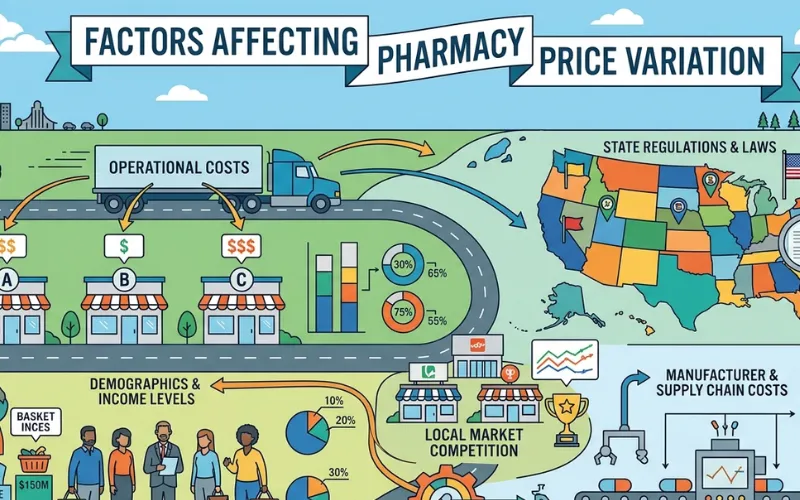
Deductibles determine whether you are paying full price or a reduced, insurance-negotiated price at any given moment in your plan year. Copays are set by your plan’s formulary tier for a given drug, not by the drug’s actual cost to acquire. Pharmacy networks affect both your copay, if your plan has preferred and non-preferred pharmacies, and your cash price, which pharmacies set independently. Drug formularies determine which medications are preferred, and formulary placement can shift year to year. Quantity affects total price and sometimes per-unit price, particularly for 30-day versus 90-day fills. Manufacturer matters because multiple companies may produce the same generic at different prices, and because manufacturer assistance programs are specific to that manufacturer’s own products. Strength affects price independently of dose, since each strength can carry different manufacturer pricing and generic competition. Location affects pricing because pharmacy costs and even insurance plan terms can vary by state and by ZIP code. None of these factors work in isolation, which is why comparing your actual options for your actual prescription, rather than assuming a general rule applies, remains the most reliable approach.
This article provides general information only and is not individualized medical, financial, or insurance advice. Prescription prices, program eligibility, and plan rules vary by insurer, medication, pharmacy, and location, and can change over time. Never stop, split, switch, or change the dose of any medication without approval from your prescriber and pharmacist.
Frequently Asked Questions
What is the fastest way to lower a monthly prescription bill?
Comparing prices for your exact medication, strength, and quantity across pharmacies, insurance, cash, and discount-card options is usually the fastest way to see where the actual savings are, since the cheapest option varies by drug and by plan rather than following one universal rule.
Will a generic medication always be cheaper than the brand-name version?
Generics are typically less expensive than their brand-name counterparts, since they do not carry the same research and marketing costs, but not every medication has a generic available, and switching should always be confirmed as appropriate with your prescriber or pharmacist first.
Is a 90-day supply always cheaper than a 30-day supply?
No. A 90-day supply often costs less per dose when a plan’s 90-day copay is set lower than three times the 30-day copay, but this depends on your specific plan, and some plans do not offer any savings from consolidating fills.
Does using a prescription discount card count toward my insurance deductible?
Generally, no. Deductible and out-of-pocket maximum tracking is based on claims processed through your insurance. A cash or discount-card payment made outside your insurance typically is not recorded toward those limits.
Can I change my prescription’s dose or quantity on my own to save money?
No. Any change to your dose, formulation, quantity, or medication should be made only with your prescriber’s and pharmacist’s approval. Cost-saving strategies should never involve stopping, splitting, or adjusting a medication without their guidance.











Trackbacks/Pingbacks