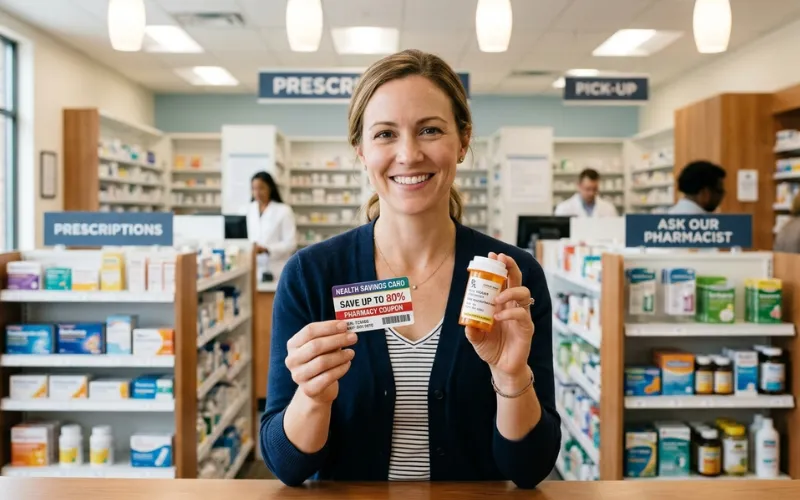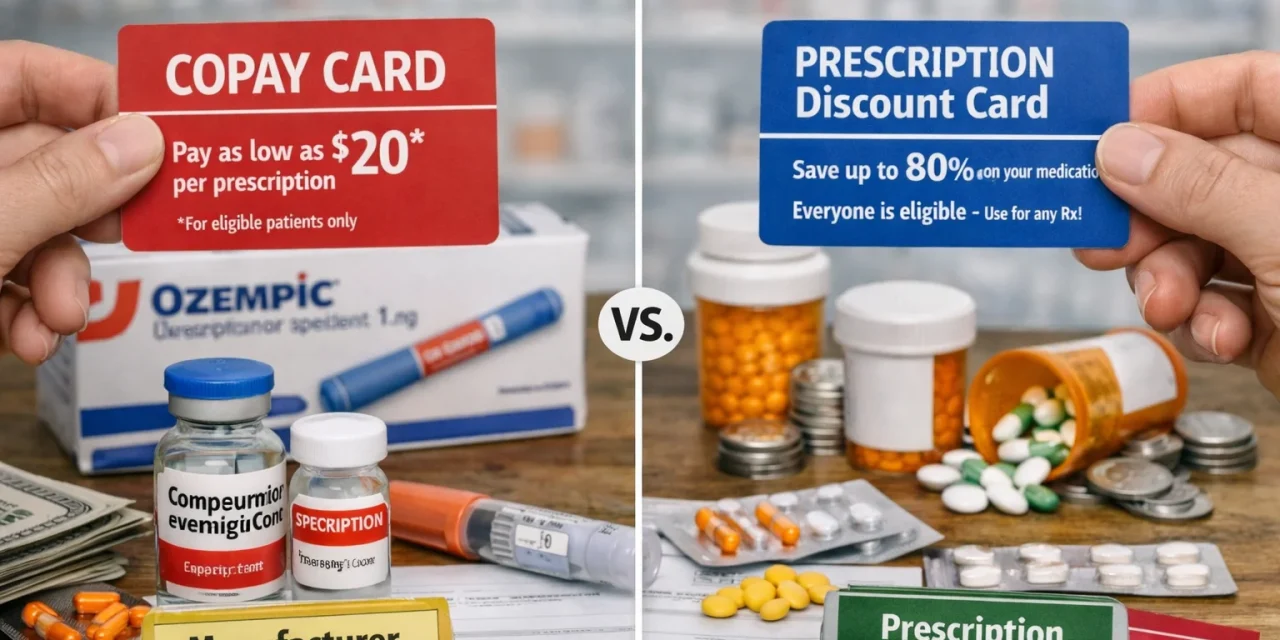
A manufacturer copay card is issued by the drug company that makes a specific brand-name medication, works alongside your existing insurance to reduce your copay, and is generally off-limits to Medicare, Medicaid, and other government insurance patients. A prescription discount card is issued by an independent third party, works instead of insurance rather than alongside it, applies to a broad range of brand and generic drugs, and is open to anyone regardless of insurance status. They solve overlapping but distinct problems, and knowing which one applies to your situation avoids a common source of confusion at the pharmacy counter.
Both tools are commonly called “coupons” in casual conversation, which is part of why people mix them up. Both reduce your out-of-pocket cost at the pharmacy. Both are presented the same way, as a card or code at the counter. But they come from entirely different sources, follow different rules, and are built to solve different financial problems, so understanding the distinction actually changes which one you should reach for on a given prescription.
What a Manufacturer Copay Card Is
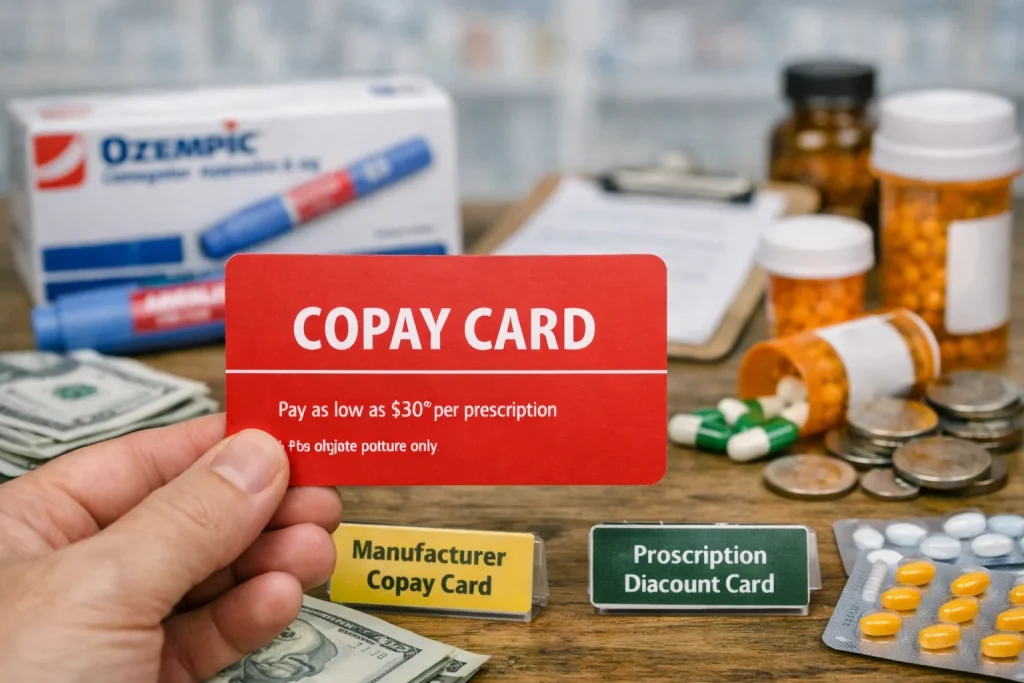
A manufacturer copay card, sometimes called a copay coupon or copay assistance program, is issued directly by the pharmaceutical company that makes a specific brand-name drug. It’s designed to reduce what an already-insured patient pays out of pocket, supplementing the insurance claim rather than replacing it. If your insurance copay for a drug is $75, a manufacturer copay card might reduce that to $10 or $25, with the manufacturer covering the difference.
These programs are almost always limited to brand-name medications, particularly ones without a generic equivalent on the market, since the manufacturer’s underlying goal is to keep patients on their specific product rather than switching to a cheaper generic or competitor drug. Most copay cards cap the total dollar amount of assistance per fill or per year, and many require a fresh card or re-verification periodically.
What a Prescription Discount Card Is
A prescription discount card, like NuLifeSpan Rx, comes from an independent company, not a drug manufacturer or your insurer, that negotiates reduced cash rates with a network of pharmacies. When you present the card, the pharmacy processes your purchase as a cash transaction at that negotiated rate instead of billing an insurance claim or a manufacturer program.
Discount cards apply broadly across brand-name and generic medications, aren’t tied to any single drug company, and have no insurance requirement, no income verification, and typically no enrollment fee. Anyone can use one for any eligible prescription at a participating pharmacy.
The Core Difference: Supplementing Insurance vs. Replacing It
According to KFF’s analysis of copay assistance programs, manufacturer copay cards are specifically designed to work in conjunction with commercial insurance, applying on top of an existing claim to reduce the patient’s cost-sharing responsibility. Prescription discount cards, by contrast, are designed to be used instead of insurance; the transaction bypasses insurance billing entirely and is processed as a straightforward cash sale at the card’s negotiated rate.
This single distinction explains most of the practical differences between the two. A copay card needs an active insurance claim to attach to; a discount card needs the opposite, insurance to be set aside for that transaction.
Side-by-Side Comparison
| Manufacturer Copay Card | Prescription Discount Card | |
| Issued by | The drug manufacturer | An independent third-party company |
| Works with insurance or instead of it | Alongside an existing insurance claim | Instead of insurance, as a cash transaction |
| Drug coverage | Usually one specific brand-name drug | Broad range of brand and generic drugs |
| Requires insurance to use | Yes, in almost all cases | No |
| Medicare / Medicaid eligible | No, generally prohibited by federal law | Yes, open to anyone regardless of coverage |
| Typical savings structure | Reduces your copay by a set amount or to a flat fee | Applies a pre-negotiated reduced cash price |
| Cost to the patient to enroll | Usually free, sometimes requires activation | Usually free, no enrollment required |
Why Medicare and Medicaid Patients Can’t Use Copay Cards

This is one of the most consequential differences and a frequent source of frustration for patients who assume any advertised drug coupon applies to them. Federal law generally prohibits the use of manufacturer copay cards for patients covered by Medicare, Medicaid, TRICARE, or other government health programs. The reasoning ties back to federal anti-kickback rules, which restrict manufacturers from directly subsidizing costs in a way that could be seen as inducing use of a specific drug under a government program.
Prescription discount cards face no such restriction, since they aren’t tied to a specific manufacturer’s product and don’t interact with insurance billing at all. Is a Prescription Discount Card the Same as Health Insurance? covers the related question of how discount cards relate to insurance coverage more broadly, which is useful background if you’re weighing this alongside the copay card question.
Which One Actually Saves You More?
Neither tool wins in every situation; which one produces the better price depends entirely on your specific circumstances.
A Copay Card Usually Wins When:
- You have commercial insurance that already covers the specific brand-name drug.
- The drug has no generic equivalent, so a discount card wouldn’t offer as much of a price reduction relative to the insurance-negotiated rate.
- Your copay under insurance is genuinely high, and the manufacturer’s assistance brings it down significantly.
A Discount Card Usually Wins When:
- You’re uninsured, or enrolled in Medicare or Medicaid, and therefore ineligible for a manufacturer copay card entirely.
- The medication is generic, since discount cards tend to produce their strongest relative savings on generic drugs rather than expensive brand-name ones.
- Your deductible hasn’t been met yet, and the cash price beats what insurance would currently charge.
- The specific drug isn’t on your insurance plan’s formulary at all.
Can You Compare Both for the Same Prescription?
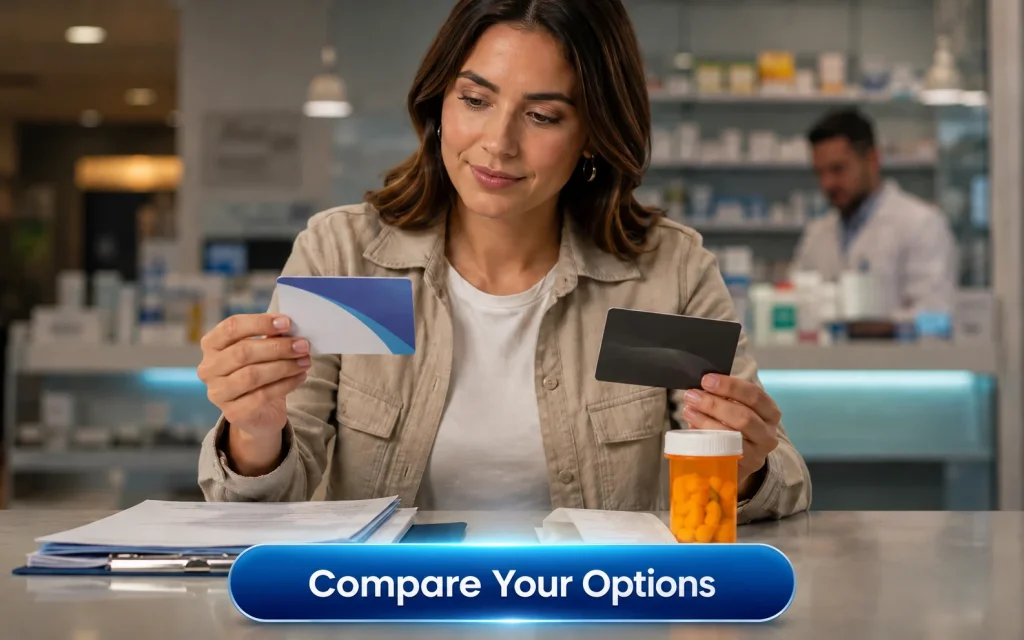
Yes, and it’s worth doing whenever both genuinely apply to your situation. Ask your pharmacist to check the price under your insurance with the manufacturer copay card applied, and separately, the NuLifeSpan Rx prescription discount card price as a cash transaction. You can’t combine the two on one purchase, but comparing them takes under a minute and ensures you’re paying the lower of the two for that specific fill.
How This Fits with Other Savings Strategies
Both tools are just two pieces of a broader savings picture. Prescription Drug Plans vs Discount Cards: Which Actually Saves You More looks at the related question of insurance plan design versus discount cards more broadly, and How Do Free Prescription Discount Cards Work? explains the mechanics behind how a card like NuLifeSpan Rx negotiates its rates in the first place.
Frequently Asked Questions
Can I use a manufacturer copay card and a prescription discount card at the same time?
No, not on the same transaction. A copay card requires an active insurance claim to attach to, while a discount card bypasses insurance entirely as a cash purchase. You choose one approach per fill, though you’re free to compare both prices beforehand and use whichever produces the lower cost.
Why can’t Medicare patients use manufacturer copay cards?
Federal anti-kickback rules generally prohibit manufacturers from offering copay assistance to patients enrolled in Medicare, Medicaid, TRICARE, or other government health programs. This restriction doesn’t apply to independent prescription discount cards, which aren’t tied to any single manufacturer’s product and don’t interact with insurance billing.
Do discount cards work on brand-name drugs the way copay cards do?
Discount cards can be applied to brand-name drugs, but they typically produce smaller relative savings on brand-name medications than manufacturer copay cards do, since a copay card is specifically designed to reduce that drug’s cost. Discount cards tend to be strongest on generic medications, where the negotiated cash rate is often dramatically lower than any insurance copay.
Are manufacturer copay cards free to use?
Most manufacturer copay cards have no direct cost to the patient beyond activating or registering for the program, similar to a discount card. The value comes from the manufacturer subsidizing part of your insurance copay, not from any fee the patient pays to participate.
What happens if my copay card runs out of its annual maximum?
Many manufacturer copay cards cap the total dollar amount of assistance available per year, and once that cap is reached, your standard insurance copay applies for the rest of the year unless the program renews. This is a good moment to check whether a prescription discount card would produce a lower price than your now-unassisted copay for the remainder of the year.
Conclusion
Manufacturer copay cards and prescription discount cards both reduce what you pay at the pharmacy, but they’re built for different situations. A copay card supplements an existing insurance claim and is limited to a specific brand-name drug and to commercially insured patients. A discount card replaces the insurance claim entirely, works across a broad range of medications, and is open to anyone regardless of coverage, including Medicare and Medicaid patients who are excluded from most copay card programs. Knowing which tool applies to your specific drug and coverage situation, and comparing both when they do overlap, is the most reliable way to make sure you’re never overpaying at the counter.
Medical information disclaimer: This article is for general informational purposes only and is not medical, legal, or financial advice. Manufacturer copay card terms, eligibility rules, and annual caps vary by program and change over time. Consult the specific manufacturer program, your pharmacist, or your insurer for current terms before relying on any single savings option.