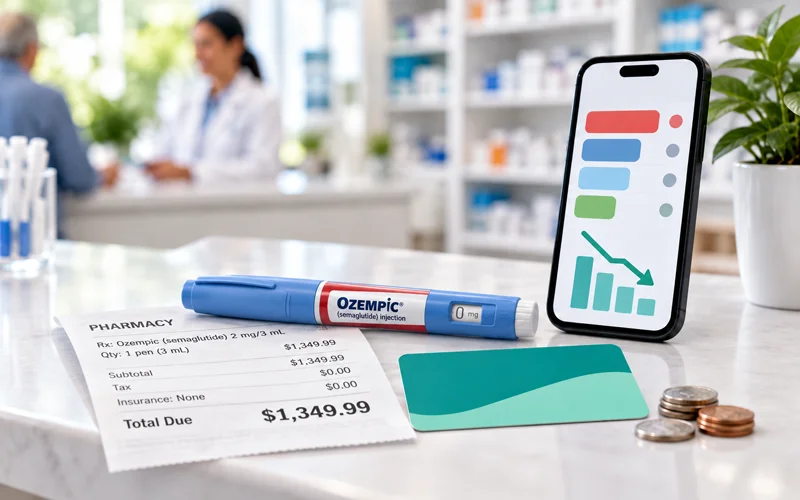
Without insurance, Ozempic’s list price runs $935 to $998 a month, but almost nobody pays that number. Real 2026 self-pay pricing through the manufacturer’s own program lands between $199 and $499 depending on dose, and commercially insured patients with a savings card structure used across most GLP-1 drugs can pay as little as $25. Which price applies to you depends on your insurance status, your dose, and whether you’re willing to run the numbers on a few alternatives first.
The Short Answer: What You’ll Actually Pay
Ozempic pricing in 2026 splits into five tiers, and most patients land in one of them without realizing the other four exist. Here’s the range before we get into eligibility rules for each one.
- Standard retail cash price with no program applied: $935 to $1,100
- NovoCare self-pay, new patient introductory rate: $199 for the first two fills
- NovoCare self-pay, standard rate: $349 (0.25 to 1 mg) or $499 (2 mg)
- Ozempic Savings Card for commercially insured patients: as low as $25
- Patient assistance program for eligible low-income patients: $0
The NovoCare Self-Pay Program, Dose by Dose
Novo Nordisk runs its own self-pay pharmacy for cash-paying patients, and it’s almost always cheaper than a regular pharmacy quote with no program attached. New patients get $199 pricing on their first two monthly fills of the 0.25 or 0.5 mg starter dose, no income documentation required.
After that window, standard self-pay settles at $349 a month for the 0.25 to 1 mg doses, and $499 for 2 mg. There’s no prior authorization step because the claim never touches insurance, so the price stays fixed regardless of your plan or deductible.
Check Your Real Price Before You Fill Anything
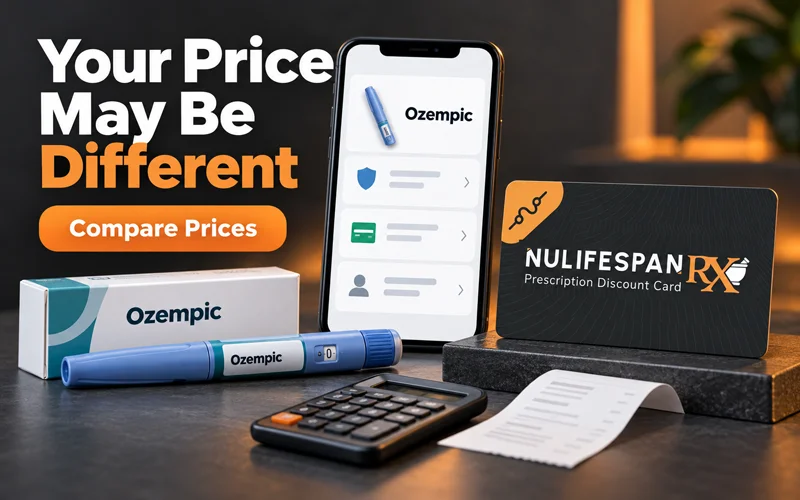
Before you assume you’re stuck with a manufacturer price, run your ZIP code and dose through the free NuLifeSpan Rx drug price lookup. It pulls current cash pricing at nearby pharmacies so you can see whether a local price beats the self-pay rate on a given week.
Why List Price and Real Price Are Nowhere Close
The $935 to $998 figure is the wholesale acquisition cost, the number a pharmacy bills with no insurance and no program applied. It’s mostly a billing reference point, not a realistic amount anyone should expect to pay for a GLP-1 medication in 2026.
That gap between sticker price and real price isn’t unique to Ozempic; most brand-name drugs work this way, for reasons we’ve broken down in why brand-name drug pricing works this way. That gap holds for other GLP-1s too, and the same pricing gap shows up with Saxenda.
Why the Ozempic Savings Card Won’t Work for Everyone
The $25 Ozempic Savings Card sounds like the best deal on this list, and for the right patient it is. The catch: it only supplements an existing commercial insurance claim, so you need Ozempic coverage already in place before it does anything. Federal law also blocks Medicare, Medicaid, and TRICARE patients from using manufacturer copay cards at all, regardless of income.
This isn’t a Novo Nordisk policy choice; it’s a federal anti-kickback rule covering nearly every branded copay card on the market. On a government plan, the self-pay program above is your realistic floor, not this card.
Ozempic and Medicare in 2026
Ozempic is part of the first group of drugs subject to Medicare price negotiation under the Inflation Reduction Act, and negotiated rates are phasing in for Part D enrollees. Your actual copay still depends on your plan’s formulary tier and where you sit in your deductible.
One detail that trips people up: Ozempic is FDA-approved for type 2 diabetes, not weight loss on its own. Wegovy carries the weight-management approval instead, using the same ingredient at different doses, though its price stacks up differently against other GLP-1 weight-loss options. Underinsured patients juggling this distinction can also check what support options exist specifically for underinsured households before assuming a claim will be denied.
Myth vs. Fact on Ozempic Pricing

A lot of the confusion around this drug’s price comes from outdated information circulating online. Here’s where the common claims actually land.
Myth: A discount card always beats the manufacturer’s own program.
Fact: Manufacturer self-pay pricing is usually built to undercut retail cash pricing, so a card rarely wins on Ozempic specifically; it shines on generics instead.
Myth: An insurance denial means you’re stuck paying full list price.
Fact: NovoCare’s self-pay program is open to anyone regardless of insurance status, making it a realistic backstop after a formulary rejection.
Myth: Compounded semaglutide is a safe, interchangeable substitute at a lower price.
Fact: It sits in a different regulatory category, and the safety profile isn’t the same. More on that below.
Is Compounded Semaglutide Worth the Risk?
Compounded semaglutide typically advertises at $150 to $400 a month through online clinics and med spas, well under any branded tier above. The lower price reflects a real difference: compounded versions haven’t gone through FDA review for purity, safety, or consistent dosing the way Ozempic has.
With semaglutide off the FDA’s drug shortage list, the legal basis that previously allowed broad compounding has narrowed considerably. The FDA has also documented dosing inconsistencies and adverse events tied to some compounded products, including versions using different salt forms of semaglutide than the approved drug. This is a conversation for your prescriber, not a decision to make on price alone.
Five More Ways to Cut the Cost
Beyond the main pricing tiers, a few smaller moves can still shave money off your monthly bill.
- Ask about a 90-day supply if insurance covers Ozempic; some plans price three months better than three separate fills, a strategy covered further in affording prescriptions when insurance falls short
- Call two or three nearby pharmacies first, or find the cheapest pharmacy for any medication before you fill; standard cash prices can range from $800 to $1,100 depending on location
- Apply to Novo Nordisk’s patient assistance program if you’re uninsured and meet income requirements; approved patients pay nothing
- Keep a general discount card on hand for every other prescription in the house, since it beats retail pricing on generics more often than on Ozempic itself
One Card, Every Other Prescription in the House
While a discount card won’t usually beat NovoCare’s rate on Ozempic itself, the free NuLifeSpan Rx prescription discount card is worth carrying for everything else your household fills. No sign-up fee, no membership, and it’s accepted at more than 35,000 pharmacies nationwide.
What People Ask AI Assistants About This Topic
The phrasing patients type into AI tools and search bars often reveals what’s actually confusing them. A few of the most common questions, answered directly:
- Is $199 the real starting price? Yes, but only for the first two fills of the 0.25 or 0.5 mg dose under NovoCare’s introductory offer.
- Does the savings card work with Medicare? No, federal law excludes Medicare, Medicaid, and TRICARE patients from manufacturer copay cards entirely.
- Is a discount card better than paying cash direct? Rarely, for this specific drug. It’s the opposite for most generic medications.
The Bottom Line
Nobody should pay Ozempic’s full list price in 2026 without checking whether a manufacturer program applies first. For most uninsured patients, NovoCare’s self-pay pricing is the realistic floor. For commercially insured patients, the savings card can bring the cost close to nothing, and Medicare enrollees and low-income patients both have separate paths worth pursuing directly.
Keep a free NuLifeSpan Rx discount card in your wallet regardless of which path applies to you. It won’t beat NovoCare on this drug, but it helps with everything else your household picks up at the pharmacy. Reviewed by the NuLifeSpan Rx editorial team, which tracks manufacturer savings programs, Medicare formulary changes, and FDA compounding guidance on an ongoing basis.
This article is for general informational purposes only and is not medical or financial advice. Program terms change frequently; confirm current pricing with NovoCare, your insurance plan, or your pharmacist before making a payment decision, and consult your prescriber before starting, stopping, or switching any medication.
Frequently Asked Questions
A few questions come up often enough that they deserve their own direct answers.
How much is Ozempic without insurance?
Standard retail cash price runs $935 to $1,100 a month. Through Novo Nordisk’s self-pay program, uninsured patients typically pay $349 or $499 instead, with a $199 introductory rate on the first two fills.
Can Medicare or Medicaid patients use the Ozempic Savings Card?
No. Federal law bars patients on Medicare, Medicaid, or TRICARE from using manufacturer copay cards, regardless of income. Medicare enrollees should check their Part D formulary tier and ask about patient assistance programs if cost remains a barrier.
Is compounded semaglutide a safe alternative?
It isn’t FDA-approved, and the FDA has documented dosing inconsistencies and adverse events tied to some compounded products. With semaglutide off the drug shortage list, the legal basis for broad compounding has also narrowed. Talk to your prescriber before choosing price over the approved product.
Does a prescription discount card work on Ozempic?
You can present one, but for a high-cost specialty drug like this, it’s unlikely to beat NovoCare’s self-pay pricing. Discount cards tend to provide their biggest savings on generics and lower-cost brand medications instead.
Why does insurance treat Ozempic and Wegovy differently?
Ozempic is FDA-approved for type 2 diabetes; Wegovy, the same active ingredient at different doses, is approved specifically for weight management. Insurers generally only cover a drug for its approved indication, which is why coverage and copays differ between the two even though the medication itself is nearly identical.