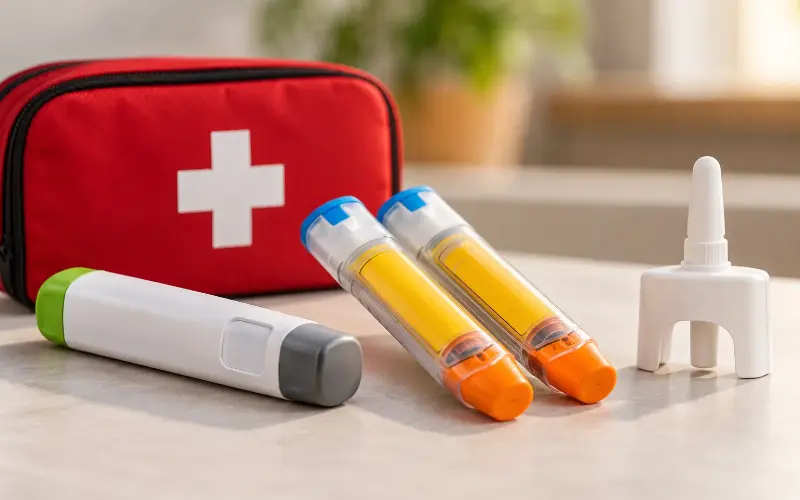
A brand-name EpiPen two-pack can cost more than $600 at the pharmacy counter when you pay cash, and that is for a medication you hope never to use. For people with limited or no prescription coverage, the EpiPen cost without insurance often comes with a multiplier: a set for home, another for school or work, and a full replacement every time the devices expire. Brand-name EpiPen, however, is rarely the only prescribed option.
Generic auto-injectors, a needle-free nasal spray, and manufacturer assistance programs can all change what you pay. Here is how those options compare and how to plan refills so you are never without epinephrine.
Check epinephrine prices before your next refill. Brand and generic auto-injectors can differ by hundreds of dollars, and cash prices change from pharmacy to pharmacy. Search your prescribed product to see what participating pharmacies near you charge.
How Much Does an EpiPen Cost Without Insurance?
A published review of pharmacies that post cash prices, conducted in early October 2026, found brand-name EpiPen and EpiPen Jr two-packs priced at about $609 to $657. Other national price-comparison services list average retail prices higher still, roughly $710 to $815 for one carton of two 0.3 mg auto-injectors. These are pharmacy cash prices, not list prices or assistance-program costs.
Generic auto-injectors in the same October review ranged from about $190 to $555 per two-pack, with the lowest prices limited to a membership-based warehouse pharmacy. The generic is usually cheaper, but the pharmacy you choose can matter almost as much as the product.
Expect the cost to repeat. Epinephrine expires, so most patients refill at least yearly, and households keeping separate sets for school or work multiply the total. Budget for a full year of devices, not a single carton.
EpiPen vs. Generic Epinephrine: Understanding the Cost Difference
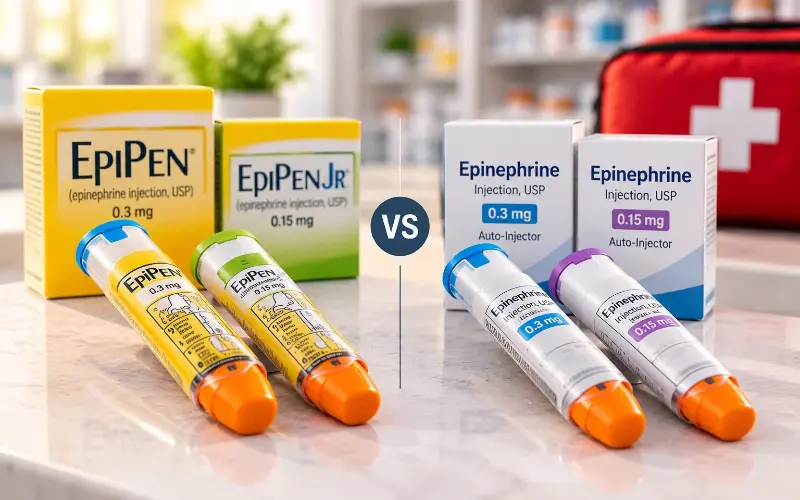
EpiPen’s maker, Viatris, sells an authorized generic, which is the same auto-injector design from the same manufacturer, marketed without the brand name and at a lower price. Separately, the FDA approved Teva’s generic version of EpiPen and EpiPen Jr in 2018. All of these deliver epinephrine in 0.3 mg doses for adults and larger children and 0.15 mg doses for smaller children, as prescribed.
The price gap comes from branding and competition, not from a difference in the medication. For an uninsured family, choosing a generic can save hundreds of dollars a year without changing the active drug.
Device design is where care is needed. Pharmacists can substitute a generic that the FDA rates as therapeutically equivalent to the prescribed product, subject to state law, but not every epinephrine auto-injector carries that rating for EpiPen. Devices also differ in their steps and safety caps, so if your product changes, ask the pharmacist for a walkthrough and update school or caregiver action plans.
What Other Emergency Allergy Medications Are Available?
Beyond EpiPen and its generics, a few other FDA-approved epinephrine products may be options to discuss with your prescriber. Auvi-Q is a brand-name auto-injector that gives spoken instructions during use and comes in a 0.1 mg dose for infants and toddlers in addition to 0.15 mg and 0.3 mg.
In August 2024, the FDA approved neffy, the first epinephrine nasal spray for emergency treatment of allergic reactions including anaphylaxis, initially for adults and children weighing at least 66 pounds; a lower-dose version for smaller children was approved later. The FDA’s announcement of the neffy approval notes that nasal conditions such as nasal polyps or a history of nasal surgery may affect absorption, so it is not the right choice for everyone. These products are not automatically interchangeable with an auto-injector, and switching requires a new prescription and your prescriber’s review.
| Product | Type | Doses available | Cash price notes (two devices) |
| EpiPen / EpiPen Jr | Brand-name auto-injector | 0.3 mg, 0.15 mg | About $609 to $657 at pharmacies posting cash prices, early October 2026 |
| Epinephrine auto-injector, authorized generic of EpiPen | Generic auto-injector, same design as EpiPen | 0.3 mg, 0.15 mg | Part of the generic range of about $190 to $555, early October 2026 |
| Teva generic epinephrine auto-injector | Generic auto-injector | 0.3 mg, 0.15 mg | Part of the generic range above; varies by pharmacy |
| Auvi-Q | Brand-name auto-injector with voice guidance | 0.3 mg, 0.15 mg, 0.1 mg | No verified current cash price; ask about the manufacturer’s access program |
| neffy | Epinephrine nasal spray | 2 mg, 1 mg | Manufacturer announced a $199 cash price for two devices at its 2024 launch; confirm current terms |
Cash or manufacturer-announced program prices, not insurance copays; subject to change. Your prescriber decides which product and dose fit.
One option the table leaves out on purpose is antihistamines. Over-the-counter allergy medicines can ease mild symptoms like itching or hives, but they do not treat anaphylaxis and are not a lower-cost substitute for epinephrine.
Why Is Epinephrine Often Sold in Two-Packs?
A severe allergic reaction does not always respond to a single dose, and symptoms can return after the first dose wears off. The FDA notes, for both injectable epinephrine and the nasal spray, that a second dose may be given if symptoms do not improve or get worse, which is why allergists commonly advise keeping two doses within reach.
That medical reason shapes the price. Most products are dispensed as cartons of two that pharmacies generally cannot split, so a $600 two-pack works out to about $300 per dose. Plan in pairs: one two-pack for each place you need protection, rather than single devices spread across locations.
Make your next refill cost less. The free NuLifeSpan Rx discount card can lower prices on eligible prescriptions at participating pharmacies. It is not insurance, and discounts vary, so check your prescribed epinephrine product before refill day.

Manufacturer Savings Programs and Financial Assistance
Manufacturer help comes in two different forms. Savings cards (copay cards) lower costs for people with commercial insurance and generally cannot be used by uninsured patients. Patient assistance programs are designed for people with financial need and can provide medication at reduced or no cost.
For EpiPen, Viatris runs a patient assistance program that can provide EpiPen at no cost to eligible patients without prescription coverage, based on household income limits tied to the federal poverty guidelines (currently listed at under 400 percent). Applications require prescriber involvement and income documentation. Current details are on the EpiPen access and savings programs page.
For neffy, ARS Pharmaceuticals offers a support program called neffyconnect, and at launch the company announced a cash price for patients without coverage plus free product for some who qualify. Confirm current terms before you fill. Auvi-Q’s manufacturer runs its own access programs as well.
A prescription discount card is a third path. It is free, needs no income check, and is not insurance; the program description explains how NuLifeSpan Rx discounts are applied.
How to Plan for Refills, Expiration Dates, and Storage
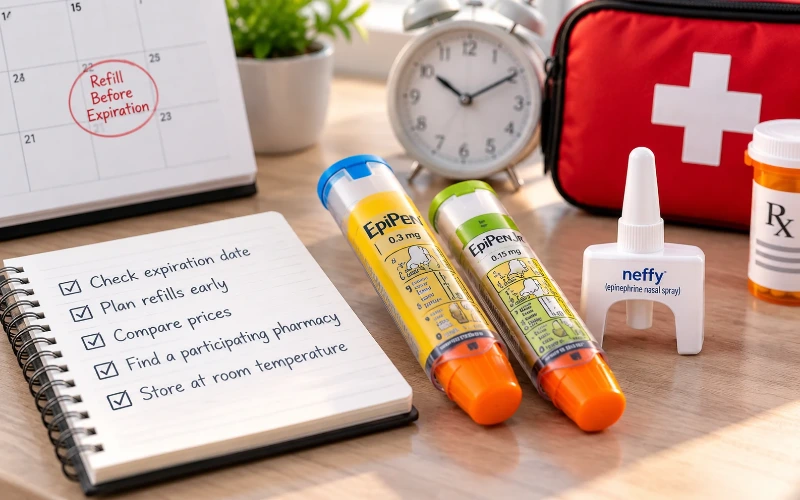
Planning prevents last-minute, full-price purchases. Check the expiration date at pickup and ask whether later-dated stock is available. A reminder a month before expiration leaves time to compare prices, apply for assistance, or find a participating pharmacy.
Keep auto-injectors at room temperature, away from hot cars and direct sun, and do not refrigerate them; neffy must also be protected from freezing. Ask your pharmacist about a replacement if an auto-injector’s solution looks discolored or cloudy. A short checklist helps:
- Two doses within reach in every place you need them
- Expiration dates on your calendar with a reminder 30 days ahead
- A written anaphylaxis action plan from your prescriber
- Updated school, childcare, or workplace forms whenever the product changes
- A price check completed before the old set expires
What to Do During a Severe Allergic Reaction
Epinephrine is the first-line treatment for anaphylaxis. If you suspect a severe allergic reaction, use epinephrine right away as your prescriber instructed, then call 911. The AAAAI Anaphylaxis Emergency Action Plan states plainly that asthma inhalers and antihistamines cannot be depended on in anaphylaxis, so do not wait to see whether an allergy pill works.
Emergency care is needed even if symptoms improve after the first dose, because reactions can return. Never delay treatment, skip a call to 911, or put off going to the emergency department because of cost. Emergency departments must screen and stabilize patients regardless of insurance status. Comparing prices is for refill day, never for an emergency.
This article is for informational purposes only and does not replace advice from a licensed healthcare professional. Medication costs and availability may vary.
Planning Ahead So Cost Never Gets in the Way
The real cost of emergency epinephrine is annual: every location that needs a two-pack, every expiration, every refill. Brand-name EpiPen sits at the top of the price range, while generics, the nasal spray, and assistance programs can lower that number considerably for eligible patients. The most effective step is to start early. Ask your prescriber which products fit your needs, ask your pharmacist about generic equivalents, and compare prices before your current devices expire. Above all, keep two doses within reach and use them without hesitation in an emergency. A refill can always be shopped for; a delayed dose cannot be undone.
Frequently Asked Questions
Is there a generic EpiPen?
Yes. Viatris sells an authorized generic of EpiPen and EpiPen Jr that uses the same device design, and the FDA approved a Teva generic in 2018. Generic auto-injectors usually cost less than the brand, though cash prices vary widely between pharmacies. Ask your pharmacist whether a generic rated as equivalent to your prescription is available.
Can I buy one EpiPen instead of a two-pack?
Usually not. Most epinephrine products are dispensed in cartons of two, and pharmacies generally cannot split them. The two-pack exists for a medical reason: some severe reactions need a second dose before emergency help arrives. Keeping both devices together, in each location where you need protection, follows standard allergy guidance and makes the price of the pack worthwhile.
Can I get a free EpiPen if I don’t have insurance?
Possibly. Viatris runs a patient assistance program that can provide EpiPen at no cost to eligible uninsured patients who meet household income limits, with an application completed alongside your prescriber. Other epinephrine manufacturers offer their own support programs. Eligibility rules change, so check the manufacturer’s current terms and ask your prescriber’s office for help applying.
Is neffy cheaper than an EpiPen?
It can be, depending on the program. At launch in 2024, neffy’s manufacturer announced a cash price for two devices that was well below typical brand-name EpiPen cash prices, but standard pharmacy cash prices for neffy can be much higher without a program. Neffy is not right for everyone, so discuss it with your prescriber before switching.
Can I use Benadryl instead of an EpiPen if I can’t afford one?
No. Antihistamines such as diphenhydramine may relieve mild allergy symptoms, but they do not treat anaphylaxis and should never replace prescribed epinephrine. If cost is keeping you from filling an epinephrine prescription, tell your prescriber and pharmacist, ask about generics, and apply for a manufacturer assistance program rather than going without.