
Reflux medication is rarely a one-off purchase. It is usually taken daily for months, sometimes for years, which means the price you pay is a price you pay again next month and the month after. That makes it worth getting right once.
The encouraging part is that most reflux prescriptions are inexpensive generics. When someone is paying for prescriptions without coverage and finds their reflux medication costing far more than expected, it almost always comes down to one of three specific causes, all of which are fixable. This guide covers what these drugs actually cost in cash, why the range is so wide, and why your medication is so expensive when a cheap version of the same thing sits on the same shelf.
What reflux medication costs without insurance
Most common reflux prescriptions fall into a low cash price band, because the drugs involved have been off patent for a long time and have many manufacturers. The expensive outliers are a small group. Prices vary by pharmacy and location, so treat the tiers below as a map rather than a quote.
- Least expensive. Omeprazole, pantoprazole, lansoprazole, and famotidine. These are high-volume generics and typically sit at the bottom of the cash price range.
- Moderate. Esomeprazole, rabeprazole, and sucralfate. Still generic, generally more than the group above.
- Most expensive. Dexlansoprazole and branded combination products. A generic dexlansoprazole did eventually reach the US market, but generic competition in this corner is thin, so cash prices stay well above the older options.
This is a common expense rather than a niche one. NIDDK estimates that about 20 percent of people in the United States have gastroesophageal reflux disease, which is roughly one adult in five.
The two drug classes and why the price gap exists
Proton pump inhibitors
Omeprazole, pantoprazole, lansoprazole, esomeprazole, rabeprazole, and dexlansoprazole belong to this class. Most have been available as generics for years, and that is the single biggest reason a reflux prescription can be cheap. Across the whole market, the Association for Accessible Medicines reports that generics account for roughly 90 percent of prescriptions filled in the United States but only around 12 percent of prescription drug spending. Older PPIs sit firmly in that inexpensive majority.
H2 blockers
Famotidine and cimetidine work by a different mechanism and are also inexpensive generics. This class used to include ranitidine, sold under the brand name Zantac. The FDA requested that manufacturers withdraw all prescription and over-the-counter ranitidine products from the US market after determining that an impurity called NDMA could increase in the drug over time and with storage above room temperature. Anyone previously taking it was moved to a different medication, which is why famotidine is now the H2 blocker most people encounter.
Three reasons people overpay for reflux medication
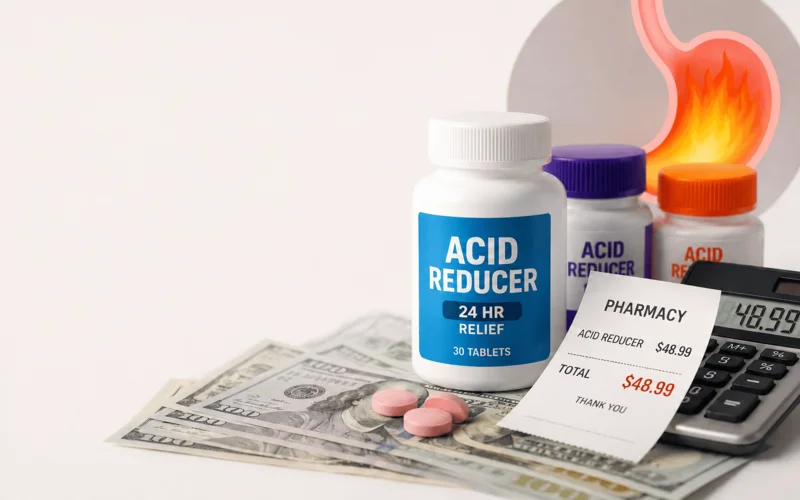
You are on the brand when a generic exists
This is the most common cause by a wide margin. The differences between generic and brand-name drugs matter far less to your wallet than the price gap suggests they should. One thing worth checking on your prescription is the DAW code on your prescription. A dispense-as-written instruction tells the pharmacist not to substitute a generic, and sometimes it is there for a clinical reason and sometimes it is a default nobody revisited. Ask your prescriber which applies to you.
You never compared pharmacies
Cash prices are set pharmacy by pharmacy, not nationally. Two pharmacies a few miles apart can quote noticeably different prices for the identical prescription, which is the mechanism behind drug prices vary between pharmacies. Because reflux medication repeats every month, finding the cheapest pharmacy once pays out for as long as you stay on the drug.
You are filling thirty days at a time
A stable, ongoing prescription is the ideal candidate for a longer fill. The arithmetic behind 90-day supply savings usually works out in your favour on maintenance drugs, and it removes two pharmacy trips and two opportunities to run out.
Why the higher dose sometimes costs less
Reflux drugs come in paired strengths, and cash pricing does not always scale with the dose. It is not unusual for the higher strength to carry a similar price to the lower one, which is the situation covered in why a higher dose prescription costs less.
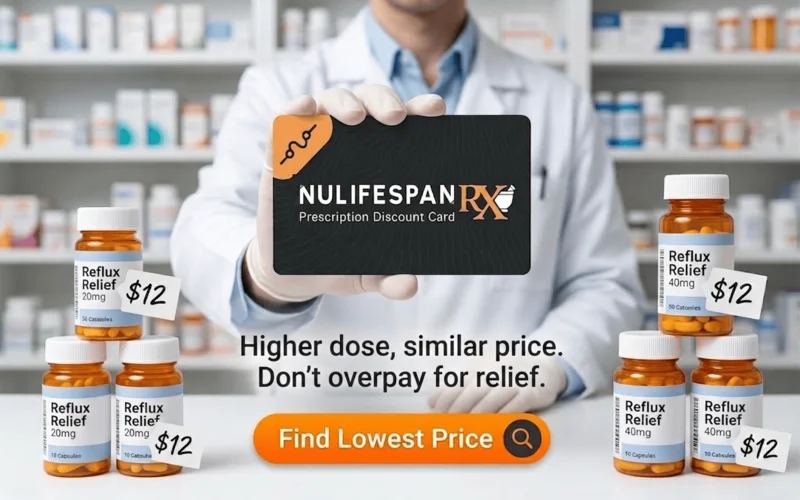
One firm caution. This is a question to raise with your prescriber or pharmacist, never a change to make yourself. Most PPIs are delayed-release capsules or tablets that must be swallowed whole and must not be split or crushed, so the approach that works for some medications does not transfer here. Ask first.
Over the counter versus prescription strength
Omeprazole, esomeprazole, lansoprazole, and famotidine all exist in over-the-counter versions at lower strengths than their prescription counterparts. That leads a lot of people to assume the two are interchangeable, and the honest answer is that it depends entirely on the strength you were prescribed and why.
There is also a practical wrinkle worth knowing. Prescription discount programs apply to prescription medications, not to over-the-counter purchases. Certain drugs available in prescription strength can be discounted when a healthcare professional prescribes them. So if you are weighing an OTC box against a discounted prescription fill, the comparison is not always the one you expect.
What you should not do is swap a prescribed dose for an OTC product on your own to save money. Talk to your pharmacist about whether it is appropriate first.
When prior authorization drives the cost
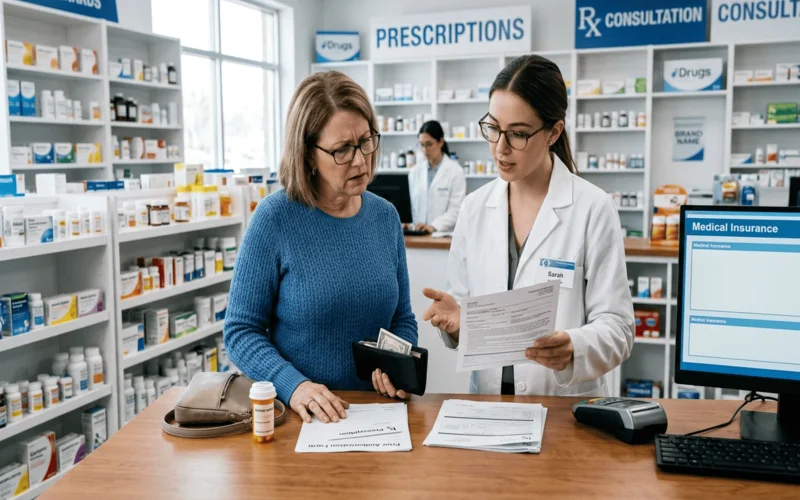
If you were prescribed one of the expensive branded options, insurance often will not pay for it until additional paperwork is approved. Understanding what prior authorization means for prescriptions helps explain delays at the counter. Worth noting is that paying the discounted cash price sidesteps this process entirely, since there is no insurer to approve anything. That occasionally makes the cash route faster as well as cheaper.
How to lower what you pay
Four steps, in order of how much they typically move the number.
Compare cash prices at pharmacies near you before you fill, and check again periodically, since prices change.
- Ask your prescriber or pharmacist whether a generic equivalent or a different drug in the same class is suitable for you.
- Ask whether a 90-day fill is appropriate for your prescription.
- If you have insurance, compare the discounted cash price against your copay before deciding which to use.
That last point catches people out. The comparison between a copay card and a discount card is worth understanding, and the broader tactics for how to lower your monthly prescription bill apply to reflux medication as much as anything else.
You can check the current cash price of your prescription at pharmacies near you with the NuLifeSpan Rx pricing tool. The card is free, requires no insurance and no enrollment fee, and is accepted at more than 35,000 pharmacies nationwide. Discounts vary by prescription and pharmacy and can reach up to 95 dollars off the retail price. The program is not insurance, and a discounted purchase does not count toward an insurance deductible or out-of-pocket maximum.
One last thing that is not about price. If your symptoms persist or get worse, that is a reason to see a clinician rather than a reason to adjust your medication yourself.
Frequently asked questions about reflux medication costs
How much does omeprazole cost without insurance?
Omeprazole is one of the least expensive reflux prescriptions to fill in cash, because it has been generic for a long time and has many manufacturers. The exact figure depends on your strength, quantity, and which pharmacy you use, so check the current price at pharmacies near you rather than assuming a national number.
Is pantoprazole cheaper than omeprazole?
Both sit in the same low band, and which one is cheaper on any given day varies by pharmacy rather than by drug. They are not interchangeable on your own, though. If you are on one and curious about the other, that is a prescriber conversation.
Why is my acid reflux prescription so expensive when the generic is cheap?
Usually one of three reasons. You are filling the brand rather than the generic, sometimes because of a dispense-as-written instruction on the prescription. You are filling at a pharmacy with a higher cash price. Or you were prescribed one of the newer options where generic competition is limited. Each of these has a different fix, so it is worth identifying which one applies.
Is over-the-counter omeprazole the same as the prescription version?
It is the same active ingredient, but OTC versions come in lower strengths than the prescription product. Whether the OTC strength is appropriate for you depends on what you were prescribed and why, so ask your pharmacist before switching.
Can I use a prescription discount card on heartburn medication?
Yes, on prescription heartburn medication. Discounts apply to prescriptions rather than over-the-counter purchases, though some drugs available in prescription strength can be discounted when a healthcare professional prescribes them.
Does a 90-day supply of reflux medication cost less?
Frequently, yes, though it depends on the drug and the pharmacy. Because reflux prescriptions tend to be long-term and stable, they are among the better candidates for a longer fill. Ask your prescriber whether a 90-day prescription is suitable in your case.
What happened to ranitidine and what replaced it?
The FDA requested that manufacturers withdraw all prescription and over-the-counter ranitidine products from the US market after finding that an impurity called NDMA could increase in the drug over time and with warmer storage. Patients were generally moved to other options such as famotidine or a proton pump inhibitor. FDA testing did not find the same problem in famotidine, cimetidine, omeprazole, esomeprazole, or lansoprazole.








Trackbacks/Pingbacks