
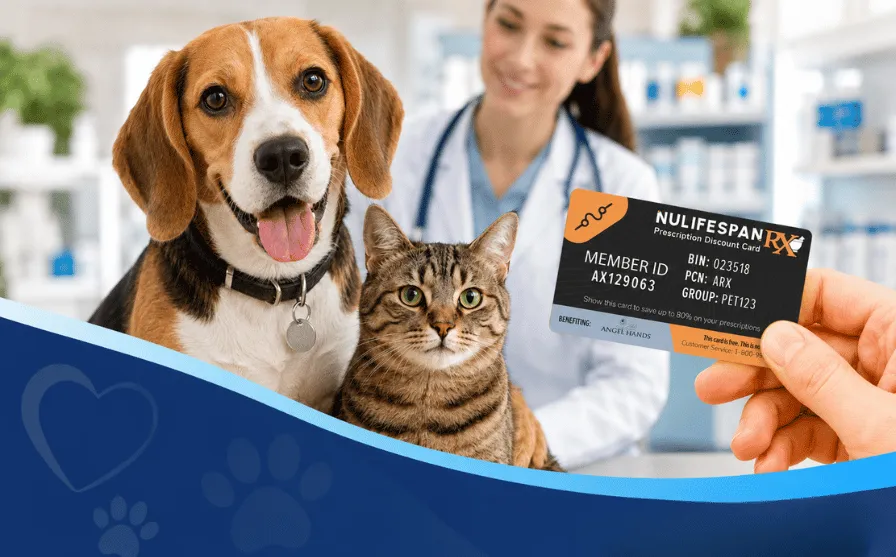
A pet prescription discount card is a free savings tool that applies a pre-negotiated cash price to eligible medications your veterinarian prescribes, at participating retail pharmacies. It is not pet insurance, and it generally works only for human medications prescribed for dogs, cats, and other pets, not for veterinary-only or compounded products. Because the price depends on the exact medication, strength, quantity, pharmacy, and ZIP code, no card is the cheapest every time. This guide explains how pet Rx discount cards work, which medications qualify, what to bring to the pharmacy, and how to compare cards and prices before you fill.
How Pet Prescription Discount Cards Work
A pet discount card for prescriptions is not insurance. It does not charge a premium, does not pay claims, and does not reimburse you after the fact. Instead, the card’s operator has negotiated a specific cash price for specific medications with a network of pharmacies, typically through arrangements with pharmacy benefit managers (PBMs). When you present the card or an app-generated coupon at checkout, the pharmacy applies that pre-negotiated price instead of its standard retail price.
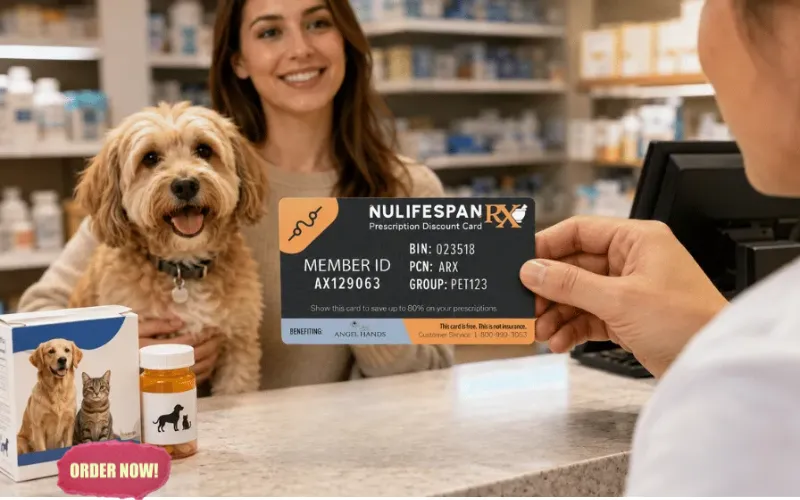
Most services that offer a prescription discount for pets are free to the pet owner. The card operator is generally paid a referral or administrative fee through the pharmacy benefit manager when a coupon is redeemed, rather than charging you directly. Pharmacy benefit managers sit between pharmacies and payers and negotiate the reimbursement terms behind each fill, a role the Federal Trade Commission examined in its interim staff report on pharmacy benefit managers. This explains why free services exist at all and why the specific price a card produces can depend on contracts you never see.
Discount Cards vs. Pet Insurance
These are fundamentally different products. Pet insurance is a policy you pay a premium for, and it typically reimburses a percentage of eligible veterinary costs, including medications in some policies, after you submit a claim and often after meeting a deductible. Coverage for pre-existing conditions is commonly excluded, and enrollment usually requires underwriting.
A prescription discount card has no premium, no claims process, and no underwriting. It simply applies a set price at the register for the specific medication you are picking up. A discount card cannot be combined with insurance on the same transaction. If you have pet insurance, whether the card or your policy produces a lower out-of-pocket cost depends on your coverage for that medication, so comparing both before you decide how to pay is worthwhile. The same principle applies to people, as our guide on discount cards and health insurance explains.
Does Pet Insurance Cover Prescriptions?
Some pet insurance policies cover prescription medications as part of accident and illness coverage, while others limit them, and preventive products are often handled through optional wellness add-ons rather than the base policy. Medications tied to a pre-existing condition are commonly excluded. Read the policy’s medication terms before assuming a refill is covered, and keep in mind that a covered prescription is usually paid upfront and reimbursed later, while a discount card lowers the price at the counter.
How to Get and Use a Pet Rx Discount Card
Using a pet drug card takes a few minutes at the pharmacy counter, and most of the work happens before you get there. The steps below apply to most discount cards for pet meds, whether you carry a printed card, a phone wallet card, or an app coupon.
- Get a written prescription from your veterinarian. Ask for the drug name, strength, quantity, dosage directions, and number of refills, and ask whether a generic is acceptable.
- Get a free card. Download or print a free discount card, or add it to your phone wallet so it is ready at checkout.
- Look up the price before you go. Search the exact medication, strength, and quantity, and compare prices at nearby participating pharmacies.
- Confirm the pharmacy will fill a veterinary prescription. A quick call saves a wasted trip, especially for controlled substances.
- Show the card when you drop off or pick up the prescription. Ask the pharmacist to run the price with the card and compare it with the pharmacy’s cash price.
- Present the card again at every refill. The discount is applied per fill, so use the card each time and recheck the price now and then.
Where Pet Prescription Discount Cards Are Accepted
Pet discount cards are used at participating retail pharmacies, which can include chain drugstores, grocery store pharmacies, and big-box store pharmacies, depending on each card’s network. Veterinary clinics that dispense medication in-house generally do not apply discount card pricing, and online pet pharmacies typically run their own pricing and coupon programs instead. Because participation can differ from one location to the next within the same chain, confirm with the specific store before relying on the card for a dog or cat prescription.
Which Pet Medications Qualify for a Discount Card
Eligibility is the point where most pet owners get surprised at the counter. Whether a pet medication discount card can lower your price depends less on your pet and more on what kind of product the veterinarian prescribed and where it is sold.
Human Medications Prescribed for Dogs and Cats
Veterinarians often prescribe human medications for dogs and cats when an approved human drug fits the condition being treated. Examples include certain antibiotics, pain and anti-inflammatory medications, and anxiety or behavior medications such as generic gabapentin or fluoxetine. When one of these is a manufactured human product stocked at a retail pharmacy, a discount card may apply, and a generic version is often priced lower than the brand. You can check the covered drugs list for the exact medication and strength before you go. Cat owners facing a high quote may also find our breakdown of cat prescription costs useful.
Why Compounded and Veterinary-Only Medications May Not Qualify
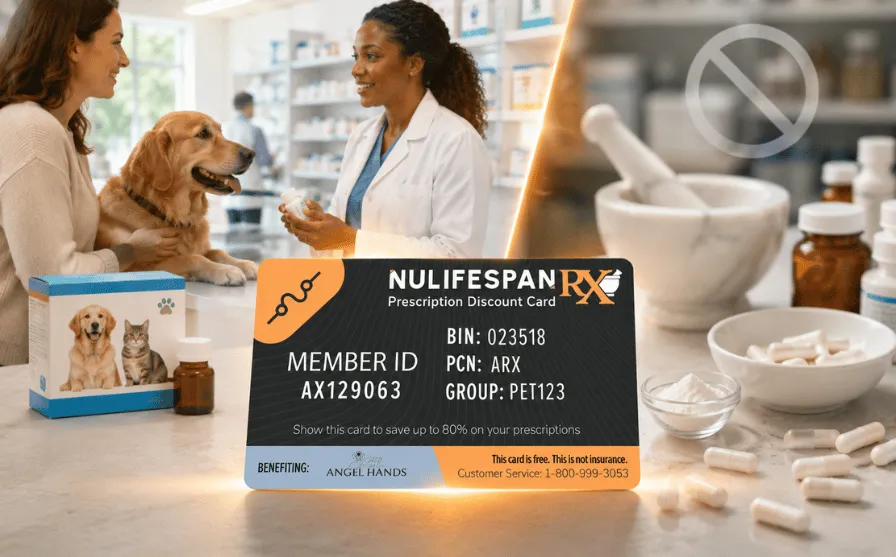
Discount cards are generally built around the pricing infrastructure used for FDA-approved, manufactured human drugs, each of which has a National Drug Code (NDC) that pharmacies and PBMs use to process a transaction. Compounded preparations, custom-mixed by a compounding pharmacist for a specific pet, are not standardized manufactured products with their own NDC, so they typically fall outside a discount card’s pricing system entirely.
Veterinary-only medications, meaning drugs approved by the FDA specifically for animal use and never sold as human retail pharmacy products, are usually not distributed through the same retail pharmacy channels a discount card network relies on. Cards built around human retail pharmacy networks generally cannot apply a discount to a product that pharmacy never stocks in the first place, which is why most third-party cash discount programs do not cover pet-only medications.
If your pet’s prescription is a compounded formulation or a veterinary-only drug, ask your veterinary clinic directly about compounding pharmacy pricing or manufacturer programs instead. Our guide to Apoquel for dogs walks through pricing options for a common veterinary-only medication.
Do Cash Discount Programs Cover Pet-Only Medications?
A common claim says most third-party cash discount programs cover pet-only medications as well as human medications that can be dispensed to animals. That statement is false. Third-party cash discount programs are built on human retail pharmacy pricing, so they generally cover human medications that can be dispensed to animals, not products made only for pets. Insulin is a useful example: some human insulin products may be prescribed for diabetic dogs and cats and priced at a retail pharmacy, while veterinary-approved insulin products typically sit outside a retail discount card’s system.
The quick reference below shows how the type of product usually decides whether a card can help.
| Product Type | Typical Examples | Can a Retail Discount Card Usually Help? |
|---|---|---|
| Human generic medication prescribed for a pet | Certain antibiotics, gabapentin, fluoxetine | Often, if the exact strength is in the card’s system |
| Human brand-name medication prescribed for a pet | Brand versions of human drugs | Sometimes, though a generic may cost less |
| Veterinary-only medication | Most heartworm preventives, prescription flea and tick preventives, veterinary-approved insulin | Usually no |
| Compounded preparation | Flavored liquids or custom-strength doses made for one pet | Usually no |
| Pet supplements | Joint, skin, and coat supplements | No, these are not prescription products |
Checking the product type first saves time, because no amount of price shopping will make a card apply to a product outside its system. If the medication falls into one of the “usually no” rows, the options in the sections below are a better place to start.
When a Retail Pharmacy May Fill a Veterinarian’s Prescription
A human retail pharmacy can fill a prescription written by a veterinarian for certain medications, but only under specific conditions. The medication must be a human drug the veterinarian has legally prescribed for extralabel (off-label) use under the Animal Medicinal Drug Use Clarification Act (AMDUCA), within a valid veterinarian-client-patient relationship. Not every retail pharmacy accepts veterinary prescriptions, so it is reasonable to call ahead and confirm before making a trip. Our guide on pet medications at human pharmacies covers how that fill works in practice, and our walkthrough of using a human pharmacy discount card for dogs shows the steps at the counter.
Information the Pharmacy May Ask For
Having the right details ready keeps the fill and the discount from stalling at the counter. The veterinarian typically must provide a written prescription that includes the drug name, strength, quantity, directions, and refill instructions. Controlled substances additionally require the veterinarian’s DEA registration number, since veterinarians do not use the NPI numbers assigned to human prescribers.
Some pharmacies also request your pet’s name, species, and birth date to set up a profile in their system, along with your own name and contact details as the owner. Bring the discount card itself or its digital version on your phone, because the pharmacist needs the card’s identifying numbers to apply the price.
Why Prices Vary by Medication, Strength, Quantity, Pharmacy, and Location
Even among eligible human medications, the price a discount card produces is not a single fixed number. It depends on the exact medication and strength prescribed, since each strength is generally priced as a separate product. It depends on quantity, since per-unit pricing can shift with the number of units dispensed, which is why comparing a 30-day vs. 90-day supply can matter for long-term medications. It depends on which specific pharmacy fills the prescription, since each pharmacy’s acquisition costs and PBM contract terms differ.
It also depends on location, since pricing can vary by state and even by ZIP code within the same pharmacy chain. The same medication can show a different discount card price at two pharmacies a few miles apart. In some cases, a pharmacy’s own cash price is lower than the card price, so checking both before you pay is worth the extra few minutes.
How to Compare Pet Rx Discount Cards
Most pet med discount cards share the same basic structure: they are free, they apply to eligible human medications rather than veterinary-only or compounded products, and they cannot be combined with insurance. Rather than ranking cards by name, the more useful comparison is the set of factors that actually change what you pay and how easy the card is to use.
Comparison Checklist
Use the factors below to evaluate any pet prescription discount card, including ours, before you rely on it for a refill.
| Factor | What to Check | Why It Matters |
|---|---|---|
| Medication eligibility | Whether your pet’s exact medication, strength, and quantity appear in the card’s search tool | Eligibility is set per product, not per pet or condition |
| Veterinary-only and compounded products | Whether the card states these are excluded | Most retail pharmacy cards cannot price them at all |
| Pharmacy network | Whether your preferred pharmacy participates, confirmed by location | A large network does not guarantee your nearest store accepts the card |
| Price transparency | Whether you can see the price by drug and ZIP code before filling | Prices vary by pharmacy and location |
| Cost to use | Whether the card is free or tied to a paid membership | A fee reduces or erases savings on low-cost generics |
| Ease of use | Whether you can print it, use an app, or add it to a phone wallet | A card you can reach at the counter is a card you will use |
| Restrictions | Whether it can be combined with insurance and how controlled substances are handled | Restrictions decide whether the card applies to your specific fill |
| Privacy | What the provider’s privacy policy says about data collection and sharing | Pharmacy transactions involve personal and prescription details |
Searching for the best pet prescription discount card usually leads to the same conclusion: the best card is the one that returns the lowest price for your pet’s specific prescription at a pharmacy you can actually use. Running the same search with two or three cards for the same medication, strength, and quantity is the fastest way to find it.
Questions to Ask Before Using a Card
A few questions are worth answering before you rely on any discount card for a pet’s medication.
- Is this specific medication, strength, and quantity listed as eligible on the card’s own search tool, rather than assumed based on a general category?
- Is the medication a human drug prescribed off-label for my pet, or is it veterinary-only or compounded, since that changes eligibility entirely?
- Is a generic version available, and would my veterinarian approve it?
- Does my preferred pharmacy participate in this card’s network, confirmed directly rather than assumed?
- Will the pharmacy accept a written prescription from my veterinarian, and does my veterinarian need to provide anything additional, such as a DEA number for a controlled substance?
- Am I comparing this price against the pharmacy’s cash price with no card, my pet insurance cost-sharing if I have a policy, and prices at more than one pharmacy?
Comparing the Card Price With the Vet Clinic, Online Pharmacy, Retail Pharmacy, and Insurance
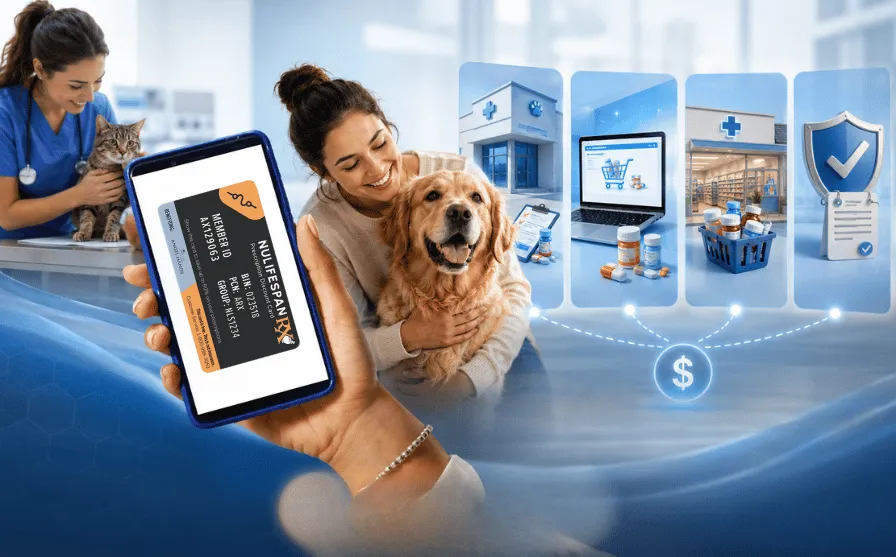
Before filling anywhere, it is worth gathering all of the following for the exact same medication, strength, and quantity. Ask your veterinary clinic what they would charge to dispense it in-house. Check a licensed online pet pharmacy’s price for the same product, confirming it is properly licensed before ordering. Check a retail pharmacy’s cash price with no discount applied.
Then check the same retail pharmacy’s price with a discount card applied. If you have pet insurance, check what your policy would reimburse or cover for that specific medication. Comparing all of these for the same exact product, rather than assuming one option is always cheapest, is the only reliable way to find the lowest actual cost. Our guide to finding the cheapest pharmacy for a prescription covers that search step by step.
Saving on Long-Term Pet Medication Without Skipping Doses
Pets with ongoing conditions such as arthritis, allergies, thyroid disease, or anxiety can need the same medication every month, so small price differences add up over a year. The safest savings come from changing how you buy the medication, never from changing how much your pet takes. Ask your veterinarian whether a generic or a different strength would work, whether a longer supply is appropriate, and whether refills can be authorized so you are not paying for extra visits.
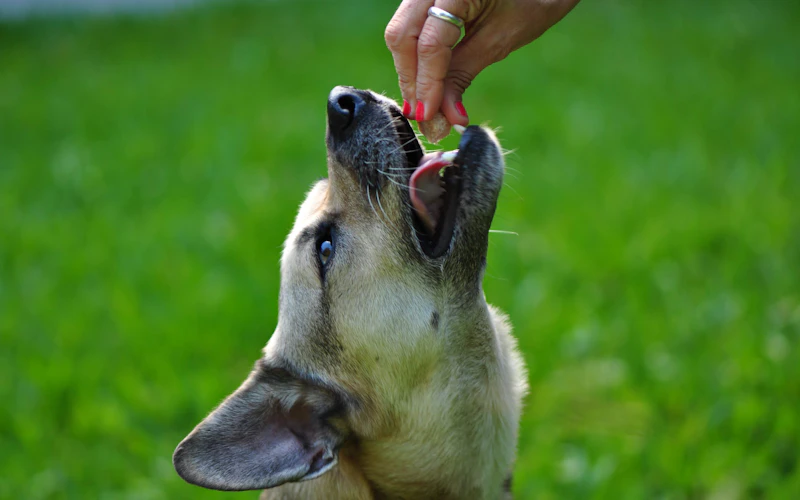
Price the refill again at least once in a while, because discount card prices and pharmacy cash prices can change. Never skip, split, or stretch doses to make a supply last longer unless your veterinarian tells you to. For more on planning around ongoing treatment, read about managing a chronic pet illness, and see our wider guide to saving money on pet prescriptions.
Other Ways to Get Pet Medication Discounts
A discount card is one tool among several, and the most affordable option for a dog or cat medication sometimes comes from a different route. These options are worth checking alongside a card price, especially for veterinary-only products a card cannot cover.
Ask Your Veterinarian About Lower-Cost Alternatives
Your veterinarian may be able to suggest a generic instead of a brand-name drug, a tablet strength that costs less per dose, or a different medication in the same class that is easier to fill at a retail pharmacy. Many clinics will also write a prescription you can fill elsewhere if you ask. Raising cost directly is normal, and it gives your vet the chance to choose an option that fits both the treatment plan and your budget.
Manufacturer Rebates and Coupons
For brand-name veterinary medications, which retail discount cards usually cannot price, some manufacturers offer rebates or coupons, often through veterinary clinics. Ask your clinic whether a rebate is available for your pet’s specific product before you buy, and read the terms, since some apply only to certain package sizes or to purchases made through the clinic.
Online Pet Pharmacies and Autoship
Licensed online pet pharmacies can be an option for veterinary-only medications and preventives that a retail discount card cannot cover, and some offer lower prices on larger quantities or recurring autoship orders. Make sure the pharmacy requires a valid prescription from your veterinarian, and compare the delivered price, including shipping, with your local options before switching.
How NuLifeSpanRX May Help With Eligible Human Medications
If your veterinarian has prescribed a human medication for your pet under extralabel use and confirmed a retail pharmacy fill is appropriate, the free NuLifeSpanRX discount card can be used for your pet the same way you would use it for yourself. You can search the medication in our pricing tool to compare prices at nearby pharmacies, then show the card at a participating pharmacy. The card is accepted at over 65,000 pharmacies nationwide, has no membership or sign-up fees, and can be printed or added to Apple Wallet or Google Wallet.
It does not apply to veterinary-only drugs or compounded preparations, for the reasons explained earlier in this article. It is not pet insurance, and it cannot be combined with an insurance claim on the same fill. Coverage, pharmacy participation, and savings vary by medication, pharmacy, and location, and are never guaranteed. For a wider look at your budget, read about the hidden costs of pet ownership.
A Note on Safety
Never give a pet a human medication, or any medication at all, without your veterinarian’s direct approval, even if a discount card shows a low price for it. Some human medications are toxic to pets in amounts that would be harmless to a person, and dosing for animals differs meaningfully from human dosing. Any change to your pet’s prescribed medication, formulation, or dose should be made only by your veterinarian.
This article provides general information only and is not individualized veterinary, financial, or insurance advice. Prices, network participation, eligibility, and program terms vary by provider, medication, pharmacy, and location, and can change at any time. Confirm current details directly with the provider and with your veterinarian before making a decision.
Frequently Asked Questions
What is a pet prescription discount card?
A pet prescription discount card is a free savings tool that applies a pre-negotiated cash price to eligible medications your veterinarian prescribes, at participating pharmacies. It is not insurance. It has no premium, no claims, and no reimbursement, and it generally works only for human medications filled at a retail pharmacy.
Do prescription discount programs cover pet-only medications?
Generally, no. Most third-party cash discount programs do not cover pet-only medications. They are built around human retail pharmacy products, so they usually apply only to human medications a veterinarian prescribes for an animal. Veterinary-only drugs and compounded preparations typically fall outside their pricing systems.
Is a pet prescription discount card the same as pet insurance?
No. A discount card applies a set price at the pharmacy counter with no premium, deductible, or claim. Pet insurance is a paid policy that typically reimburses part of eligible costs after you file a claim. The two cannot be combined on the same fill, so compare both before you pay.
What information do I need to use a discount card for my pet’s prescription?
You need a valid written prescription from your veterinarian, the card or its digital version, and the exact medication, strength, and quantity. Some pharmacies also ask for your pet’s name, species, and birth date, and controlled substances require the veterinarian’s DEA number.
Which pet prescription discount card is best?
No single card is the best for every pet. The lowest price depends on the exact medication, strength, quantity, pharmacy, and ZIP code. The most reliable approach is to search your pet’s specific prescription, compare prices at more than one pharmacy, and check the cash price without a card.
Will any retail pharmacy fill my veterinarian’s prescription for my pet?
Not necessarily. The medication generally must be a human drug your veterinarian prescribed off-label under AMDUCA, and not every pharmacy accepts veterinary prescriptions. Call ahead to confirm the pharmacy will fill it and what details it needs before you make the trip.
Are pet prescription discount card savings guaranteed?
No. Savings, pharmacy participation, and medication eligibility vary by medication, pharmacy, and location, and are never guaranteed. In some cases the pharmacy’s own cash price is lower than the card price, so checking both is the most reliable way to pay the lowest amount.
Where can I use a pet prescription discount card?
You can use it at participating retail pharmacies in the card’s network, which can include chain, grocery store, and big-box store pharmacies. Veterinary clinics that dispense in-house generally do not apply discount card pricing, so confirm with the specific pharmacy before you fill your pet’s prescription.
Can I use manufacturer coupons for pet medications?
Sometimes. Some manufacturers of brand-name veterinary medications offer rebates or coupons, often through veterinary clinics. These programs are separate from retail discount cards, so ask your veterinarian which offers apply to your pet’s specific product.










Trackbacks/Pingbacks