

The honest answer is that it depends on what you are taking and when you need to use it. Discount cards win on generics, on short-term fills, and when your insurance deductible has not been met. Prescription drug plans win on high-cost specialty medications, chronic condition management over time, and situations where annual out-of-pocket protections matter. Most patients benefit from understanding both and choosing by prescription rather than committing entirely to one approach.
What a Prescription Drug Plan Actually Is
A prescription drug plan is a formal insurance agreement that covers the cost of outpatient medications. The most common version in the U.S. is Medicare Part D, which provides drug coverage for Medicare beneficiaries either as a stand-alone plan or bundled into a Medicare Advantage plan.
The structure of a prescription drug plan involves several layers of cost that affect what you pay:
- A monthly premium paid whether or not you use the coverage
- An annual deductible that must be met before most benefits apply
- Copays or coinsurance for each prescription, which vary by the drug’s formulary tier
- An out-of-pocket maximum that caps total annual spending, after which the plan covers most remaining costs
- A coverage gap phase, sometimes called the donut hole, where cost-sharing temporarily increases before catastrophic coverage begins
Plans must cover medications across six protected drug categories to ensure access to critical treatments. They exclude over-the-counter medications, drugs used for weight management, fertility, cosmetic purposes, and certain other categories. If a specific drug is not on the plan’s formulary, patients can request an exception or appeal a denial.
What a Prescription Discount Card Is
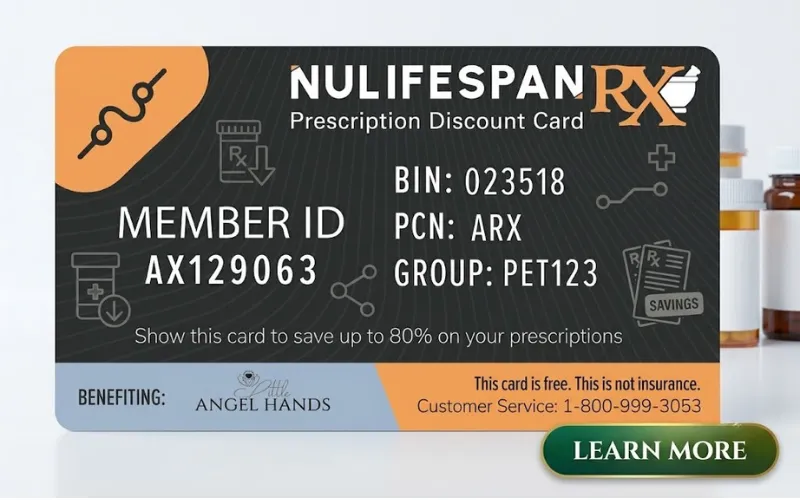
A prescription discount card is not insurance. It is a tool that connects patients to pre-negotiated rates that pharmacies have already agreed to honor through Pharmacy Benefit Manager networks. There is no premium, no deductible, no enrollment process, and no claims to file.
What makes discount cards distinctly accessible:
- Available to anyone, insured or uninsured, with no eligibility requirements
- No registration or personal information required to obtain or use one
- Savings applied immediately at the counter when the card is presented
- Covers a wide range of FDA-approved prescription drugs including generics and many brand-name medications
- Can be compared by medication, dosage, and zip code to find the best price across nearby pharmacies
The savings model works because discount card networks negotiate pharmacy rates on behalf of patients at no cost, with the card provider earning a small transaction fee from the pharmacy after each fill.
Where Discount Cards Win on Cost
For generic medications, discount cards frequently outperform prescription drug plan copays. Savings can reach 85 percent off retail prices at competitive pharmacies, and for many common generics the discounted price is genuinely low in absolute terms.
Situations where discount cards deliver better savings than insurance:
- When your deductible has not been met and your insurance charges full retail price until it is
- When your plan’s copay for a specific generic exceeds the discount card price
- When a medication is not covered by your formulary or requires prior authorization that delays access
- When you are uninsured and need immediate access to affordable medications
- When you take only a few prescriptions per year and paying a monthly premium for a drug plan is not cost-effective
Patients on high-deductible plans paying full price early in the year often find the discount card price is lower than what insurance charges until the deductible is met. Comparing both before each fill is the most reliable way to ensure you are choosing the lower option.
Where Prescription Drug Plans Win
Prescription drug plans are designed for patients with complex, ongoing medication needs, particularly where brand-name or specialty medications are involved.
Drug plans are likely the better long-term choice when:
- You manage a chronic condition requiring multiple ongoing prescriptions
- Your medication regimen includes high-cost specialty drugs where the plan’s negotiated rates and out-of-pocket cap provide meaningful protection
- You are enrolled in Medicare and need coverage that coordinates with other benefits
- Your annual medication spending is high enough that an out-of-pocket maximum would save you significant money before year-end
Structural reasons behind high specialty drug prices involve manufacturer pricing, formulary rebates, and coverage tiers where plan-based protections become the most practical financial tool available.
The Key Difference: Impact on Deductibles and Out-of-Pocket Totals
This distinction matters enormously for patients who are trying to optimize their annual healthcare spending. When you use a prescription drug plan, your prescription costs count toward your deductible and annual out-of-pocket maximum. When you use a discount card, they do not.
What this means in practice:
- Using a discount card on a $50 prescription saves you $50 now but does not move you closer to meeting your deductible
- Using insurance on the same prescription may cost you more upfront but counts toward your deductible, which could reduce what you pay for other medications and services later in the year
- For patients who are likely to hit their out-of-pocket maximum, running prescriptions through insurance early in the year accelerates reaching that cap
- For patients who rarely hit their deductible, the discount card approach may save money in every individual transaction
There is no universal right answer. The better strategy depends on your total annual prescription spending, the composition of your medication list, and where you are in your deductible cycle when you fill each prescription.
Using Both at the Same Time: What Is Actually Allowed
Discount cards and prescription drug plans cannot be combined on a single prescription fill. The Anti-Kickback Statute prohibits using a discount card alongside Medicare Part D on the same transaction, and private insurance plans have similar restrictions. You choose one or the other at the point of sale.
However, using both tools strategically across different prescriptions or different times of year is entirely reasonable and legal:
- Use the discount card for inexpensive generics where its price beats the insurance copay
- Use insurance for higher-cost medications where the plan’s formulary pricing or out-of-pocket cap provides better value
- Inform your pharmacist which option you want to use before the transaction is processed, since switching after the fact requires reversing and reprocessing the claim
Pricing details pharmacists are not obligated to share include the fact that the discount card price may be lower than your copay. The comparison is yours to make before handing over the prescription. Asking the pharmacist to check the discount card price before running it through insurance takes seconds and can produce immediate savings.
Comparing Prices Across Pharmacies Regardless of Which Option You Use
Whether you are using a discount card or insurance, pharmacy selection affects what you pay. The same prescription drug plan copay may vary across pharmacies depending on network participation. The same discount card can show meaningfully different prices at different locations for the same medication.
Pharmacy-to-pharmacy price variation on prescriptions reflects each chain’s individual contract structures within discount networks and insurance preferred networks. A medication priced at $6 at one chain using a discount card may be $12 at another for the same fill.
For patients who primarily use one chain, understanding how each handles cash-pay pricing is useful. Saving on prescriptions at CVS without a plan follows a different structure than applying discount pricing at Walgreens. Finding the lowest local price by zip code takes a few minutes and is worth confirming rather than assuming.
Special Considerations for Medicare Beneficiaries
Medicare beneficiaries face an additional factor when considering discount cards. Using a discount card instead of Medicare Part D for an extended period can trigger late enrollment penalties if you later decide to enroll in a Part D plan.
The Part D late enrollment penalty accumulates at one percent of the national base beneficiary premium per month you go without creditable drug coverage. In 2026, the base beneficiary premium is $38.99. Going without Part D for 43 months and then enrolling results in a 43 percent penalty, or approximately $16.80 added to your monthly premium indefinitely.
Discount card purchases do not count as creditable drug coverage under Medicare rules. For Medicare beneficiaries, this means a discount card is most appropriate as a supplemental tool for non-formulary drugs or medications where the card price beats the Part D copay, rather than as a wholesale replacement for Part D enrollment.
Coverage for Veterans and Other Special Populations
Veterans accessing medications through VA benefits have a distinct set of considerations. VA prescription coverage is recognized as creditable drug coverage under Medicare rules, which means veterans with VA pharmacy benefits can delay Part D enrollment without incurring the late enrollment penalty.
VA coverage provides free prescriptions primarily for veterans with service-connected disabilities rated at 50 percent or higher. Lower ratings limit coverage to prescriptions for specific service-connected conditions. Veterans in Priority Groups 2 through 8 face copays for non-service-connected conditions, capped annually.
For medications not covered under VA benefits, discount cards can bridge the gap effectively. Reducing out-of-pocket costs when coverage falls short is a strategy that applies to veterans facing coverage gaps just as it does to uninsured civilians.
Frequently Asked Questions
Can a discount card and insurance be used on the same prescription
No. Discount cards and insurance, including Medicare Part D, cannot be combined on a single prescription fill. Federal law prohibits combining discount cards with Medicare specifically, and private insurance plans have equivalent restrictions. You choose one at the point of sale. You can, however, use different options for different prescriptions in the same visit.
Does using a discount card affect my insurance benefits
Only in the sense that discount card payments do not count toward your deductible or out-of-pocket maximum. Your underlying insurance plan is unaffected. Using a card for one prescription does not impact your coverage for other services or medications.
When does a prescription drug plan save more money than a discount card
A drug plan tends to win when your medications are expensive, particularly specialty or brand-name drugs where plan-negotiated rates and out-of-pocket caps provide protection that a discount card cannot match. For patients with high annual prescription spending, hitting the plan’s out-of-pocket maximum early in the year can result in zero cost for subsequent fills, which no discount card can replicate.
Are there any fees associated with prescription discount cards
Legitimate discount cards are free to obtain and use. Some platforms offer premium subscription tiers that provide additional savings at certain pharmacies, but the base card carries no cost. Always review the terms of any card before using it to confirm there are no transaction fees or membership requirements.
Can discount cards be used for medications not covered by a drug plan
Yes. This is one of the strongest use cases for discount cards. If a medication is not on your plan’s formulary, has been denied coverage, or is subject to prior authorization you want to avoid waiting for, a discount card provides immediate access at the negotiated rate without involving your insurance at all. Understanding how discount cards cover non-formulary drugs is one of the most practical reasons to keep a card available regardless of your insurance status.
The Bottom Line
Prescription drug plans and discount cards are not competing alternatives where one wins and the other loses. They serve different purposes, and the patients who save the most are typically those who understand when each tool works in their favor. Discount cards deliver immediate, transparent savings on generics and non-formulary drugs with no commitment required. Drug plans provide structural protection for complex medication regimens and high-cost treatments over time. Comparing prices at each fill, knowing your deductible status, and asking the pharmacist to check the discount card price before processing through insurance are the three habits that together produce the most consistent savings regardless of which approach you use as your primary tool.







Trackbacks/Pingbacks