
There is no single pharmacy that is cheapest for every medication. The pharmacy that charges the least for your blood pressure tablets may charge the most for your child’s antibiotic, and the answer can change between two branches of the same chain a few miles apart.
That sounds inconvenient, and it is. It is also the reason price shopping works. Because prices vary between pharmacies for the same drug from the same manufacturer, the difference between the first pharmacy you call and the fourth is often real money, and finding it takes about ten minutes.
This guide covers how to run that comparison properly, what information you need before you start, how to read the three different prices you will be quoted, and how to handle the situations people ask about most: online pharmacies, discount cards and coupon programs, generic versus brand pricing, and medications you take every month.
What You Need Before You Compare Anything
A price quote is only useful if it describes your actual prescription. Before you call or search, write down five things from the script or the bottle:
- Drug name, including whether it is the brand or the generic
- Strength, for example 20 mg
- Quantity, for example 30 tablets or 90 tablets
- Dosage form, such as tablet, capsule, oral solution, inhaler or injection
- Your ZIP code, because pricing is local
Change any one of these and the price changes. A 90-count bottle is not three times a 30-count bottle. An oral solution is not priced like a tablet. This is the most common reason people get a quote on the phone and a different number at the counter.
How to Find the Cheapest Pharmacy for Your Medication
Step 1: Check the price at three or four pharmacies, not one
Pick a mix rather than three of the same kind. A large chain, a supermarket or big-box pharmacy, and one independent near you is a reasonable spread. Add a mail-order or licensed online option if the medication is one you take every month.
You can do this by phone or through an online prescription pricing tool. Either way, give the full five details above and ask for the price for that exact prescription.
Step 2: Ask for the cash price specifically
If you have insurance, the pharmacy will usually quote your copay by default. Ask separately what the medication costs paying cash, with no insurance run. These are two different numbers, and for generics the cash price is sometimes the lower of the two, particularly before a deductible is met.
If you do not have insurance, the cash price is your starting point, not your final one.
Step 3: Ask what the price is with a discount card applied
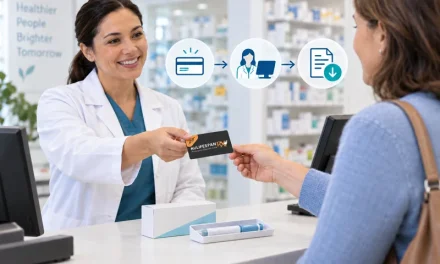
A free prescription discount card is processed as a cash transaction at a pre-negotiated rate rather than at the pharmacy’s standard retail price. The pharmacist can run it before you commit to filling.
Card prices are not uniform. The same card can produce a large reduction at one pharmacy and none at another, because the rate is negotiated per pharmacy and per drug. That is exactly why the card price has to be part of the comparison rather than a substitute for it.
Step 4: Ask the pharmacist two questions before you decide
While you have them on the phone, ask:
- Is there an approved generic for this? A generic contains the same active ingredient at the same strength and dosage form as the brand, and the FDA requires it to be bioequivalent before approval. It typically costs less because the manufacturer does not have to repeat the original clinical trials. Whether a substitution is permitted depends on how the prescription was written, so ask rather than assume. See the FDA guidance on generic drugs for the full standard.
- Would a different quantity price better? Sometimes a higher dose costs less in a way that is not proportional. Your pharmacist can check this in seconds.
Any change to strength, quantity or formulation needs approval from your prescriber or pharmacist. Ask the question; do not make the change yourself.
Step 5: Confirm the final number at the counter
Quoted prices change. Confirm the total at the pharmacy before the prescription is rung up, and tell the pharmacist which payment route you want used before they process the claim. Reversing a claim after it has run is possible but slow.
Why Prescription Prices Differ Between Pharmacies
Three things drive most of the variation.
Pharmacies pay different amounts for the same drug. Buying power and supplier contracts differ, so acquisition cost is not the same everywhere.
Each pharmacy sets its own retail price. There is no regulated ceiling on what a pharmacy can charge a cash customer, so the same generic can carry very different price tags a few miles apart.
Middlemen negotiate different rates. Pharmacy benefit managers negotiate separately with each pharmacy chain and each insurer, which is why your copay for a drug depends on where you fill it, not just what you take.
The practical consequence is the one that matters for shopping: even within a single chain, prices can differ by location.
Compare Insurance, Cash and Discount Card Prices
You are always choosing between three prices, and they are not ranked in a predictable order.
| Price type | What it is | When it tends to win |
|---|---|---|
| Insurance copay | The amount your plan sets for a covered drug at an in-network pharmacy | Brand-name drugs on formulary, and after your deductible is met |
| Cash price | What the pharmacy charges without any insurance claim | Rarely the lowest, but it is the reference point everything else is measured against |
| Discount card price | A pre-negotiated cash rate applied at participating pharmacies | Common generics, drugs your plan does not cover, and high-deductible periods |
Two rules apply to nearly every pharmacy in the country:
- A discount card and insurance cannot be applied to the same transaction. You choose one per fill.
- If you use a discount card instead of your insurance, that spending generally does not count toward your deductible or out-of-pocket maximum.
That second point matters most for anyone with high annual drug costs. Paying less today can mean reaching your plan’s protection later. Weigh prescription plans against discount cards across the whole year, not one fill at a time. If your income and resources fall below Medicare’s limits, its Extra Help program can lower Part D premiums, deductibles and copays, which changes the calculation entirely. The eligibility rules are set out on Medicare’s page on help with drug costs.
Filling with insurance is not automatically the cheaper route either. A pharmacy that looks like the best deal on your plan’s copay list can still lose to the cash or discount card price at a different pharmacy for the same drug, so run all three before assuming your insurance number is final.
How Discount Cards and Coupon Programs Compare to Each Other
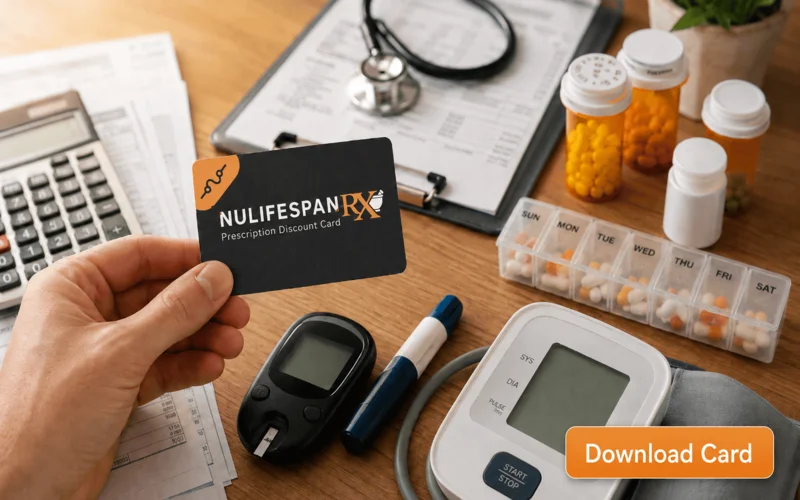
The NuLifeSpan Rx card is one of several free discount programs on the market. GoodRx, SingleCare and ScriptSave WellRx work the same basic way: a pharmacy benefit manager negotiates a cash rate in advance, and the pharmacy applies it instead of running your insurance. None of these programs contracts at a single nationwide rate. Each one negotiates separately with each pharmacy and each drug, which is why a program that wins at one counter can lose at the next, and why carrying only one card means you are seeing only one slice of the market.
A coupon for a specific drug, the kind people search for by name, is usually the same mechanism presented differently: a discount card rate tied to one medication rather than a general card. It is worth pricing alongside the cards rather than treating it as a separate category.
In practice this means checking more than one program for anything expensive or long-term, the same way you would check more than one pharmacy. A pharmacy’s own in-house savings club is a fourth option worth asking about while you are on the phone, since some of these beat the third-party cards on specific drugs and some do not. There is no shortcut that replaces comparing the actual number for your prescription.
Anyone who wants a card in the rotation can get one free at NuLifeSpan Rx, with no sign-up required for the generic version.
Are Chain Pharmacies Always Cheaper?
No. Each category of pharmacy has a structural advantage and a structural weakness, and none of them wins across the board.
National chains
Wide coverage, long hours, and reliable stock. Prices vary by location within the same brand, so a quote from one branch does not tell you what another branch charges, and one chain is not reliably cheaper than another across the board either; a common generic that is inexpensive at one national chain can be priced very differently at another, and the ranking can flip on the next drug. If you already fill at one, the specifics are worth reading up on, whether that is saving at CVS without insurance or how discount cards work at Walgreens.
Supermarket and big-box pharmacies
Often competitive on common generics, since the pharmacy counter is partly there to bring you into the store. Some run low-cost generic lists covering a limited set of medications. Worth checking whether your drug is on that list rather than assuming it is. Note that Walmart prices differ between stores as well, for the same reasons the chains do.
Independent pharmacies
Frequently overlooked and sometimes the cheapest, especially for cash-paying customers, because an independent owner can set prices without corporate pricing rules. They are also more likely to talk through options with you. Always worth one call.
Warehouse club pharmacies
Often strong on high-volume generics. In most states the pharmacy counter is accessible without a club membership, though the rules vary, so ask before you drive over.
Mail-order and licensed online pharmacies
Usually the best fit for medications you take every month rather than a one-off course. Lower overhead can mean lower prices, and 90-day supplies reduce the per-day cost. The trade-offs are shipping time and the need to plan refills ahead.
Getting the Cheapest Price From an Online Pharmacy
An online pharmacy is not automatically the cheapest option, it is a fifth pharmacy type to add to the comparison, not a replacement for it. The same rules apply: get a price for your exact drug, strength, quantity and form, and check both the cash price and any discount card the pharmacy accepts.
A few things are specific to shopping online:
- Confirm licensing before anything else. Verify that the pharmacy is licensed in your state and requires a valid prescription. The FDA’s BeSafeRx tool checks a site against state pharmacy board records. A site that will ship a prescription drug without one is not a pricing shortcut worth taking.
- Price the delivered total, not the sticker price. Add shipping and any membership or subscription fee before comparing it to a local quote. A lower per-pill price can still lose once delivery is added, particularly for a small quantity.
- Factor in timing. Mail order suits a medication you take every month and can plan around. It is a poor fit for a short course, like an antibiotic, that you need filled today.
- Ask about card compatibility. Many licensed online pharmacies accept the same discount cards as brick-and-mortar locations, so the card comparison from Step 3 still applies.
Run the online quote through the same pricing tool comparison as your local options, rather than treating “online” as a category that is settled in advance.
Does the Cheapest Pharmacy Change by Medication?
Yes, and this is the part most people find surprising.
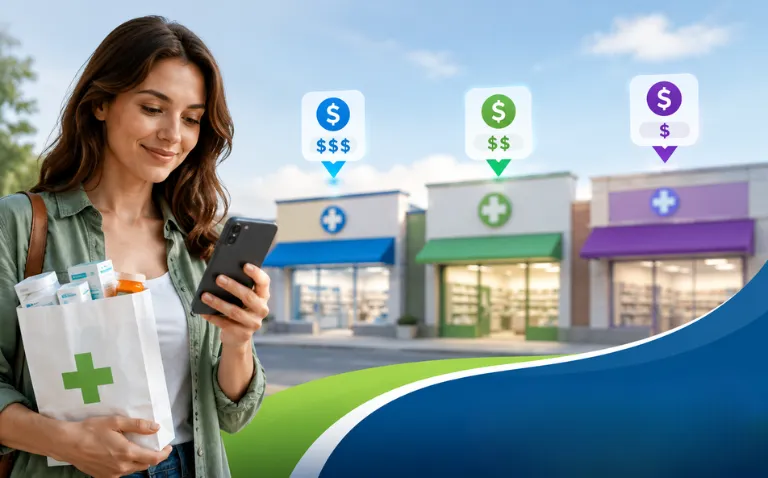
A pharmacy’s price for one drug tells you almost nothing about its price for another. Two medications sitting on the same shelf can be acquired under different contracts, discounted under different card rates, and covered at different tiers by your plan. A pharmacy that is the clear winner on a common generic can be the most expensive option for a brand-name drug with no generic available.
The practical rule: compare per prescription, not per pharmacy. When a new medication is added to your list, run the comparison again for that drug rather than defaulting to wherever you filled last time.
There is one sensible exception. If you take several medications, consolidating them at one pharmacy has real safety value, because a single pharmacy record lets a pharmacist catch duplications and interactions across everything you take. If the price difference on one drug is small, staying put is often the better call. If it is large, ask your regular pharmacy whether they will match, then decide.
Which Pharmacy Is Cheapest for Long-Term or Maintenance Medications
Medications you take every month, for conditions like high blood pressure, cholesterol or diabetes, follow a slightly different comparison than a one-time prescription, because the same small difference repeats every fill for a year or more.
Three pharmacy types tend to do well here, for different reasons:
- Mail-order and licensed online pharmacies for the reasons above: lower overhead and 90-day fills that reduce the per-day cost, provided the delivered total including shipping is actually lower.
- Warehouse club pharmacies, which are frequently strong on the common high-volume generics used for chronic conditions.
- Supermarket and big-box pharmacies running a low-cost generic list, if the specific drug happens to be on it.
Because the same drug at the same pharmacy does not usually swing wildly month to month, a maintenance medication does not need re-shopping at every single fill the way a new or short-term prescription does. Re-check every few months, or whenever your dose, insurance plan or the pharmacy’s own pricing changes, rather than assuming a price found a year ago still holds. If you take several long-term medications, it is worth pricing each one separately even if you fill them all at the same pharmacy, since the cheapest option for one is not automatically the cheapest for another.
Generic vs Brand-Name Costs
Generic medications are usually the biggest single source of savings in this comparison, and the price gap between a generic and its brand-name equivalent is often larger than people expect. The FDA requires a generic to match the brand’s active ingredient, strength and dosage form and to be bioequivalent before it can be approved. Because the manufacturer is not repeating the original clinical trial program, the generic typically reaches the market at a much lower cost, and pharmacies price it accordingly. Our full breakdown of generic and brand-name drugs covers the clinical side in more depth.
The gap is not the same for every drug, and it is not always in the generic’s favor. A newer brand-name medication with no approved generic yet has no cheaper alternative to compare against. Some manufacturers also offer a copay card for a brand-name drug that can undercut the generic’s cash price for insured patients, which is worth asking your prescriber about if a generic substitution is not an option. And if your prescription carries a DAW code blocking substitution, the generic price is not available to you at all until that is addressed with the prescriber.
The one-line version: always ask whether an approved generic exists before you start comparing pharmacies, because it usually matters more than which pharmacy you choose.
Ways to Reduce What You Pay
These sit alongside the comparison rather than replacing it:
- Ask whether an approved generic exists. If your prescription carries a DAW code blocking substitution, ask the prescriber whether that is still necessary.
- Price a 90-day supply against three 30-day fills for anything you take long term. The per-day cost is often lower, but confirm it rather than assuming.
- Check whether another formulation is cheaper. Tablets, capsules and solutions of the same drug can price very differently. Only your prescriber or pharmacist can tell you whether a swap is clinically appropriate.
- Ask about the pharmacy’s own savings program. Many run one, and the terms differ from the third-party discount cards.
- Re-check periodically. Prices move. A comparison from a year ago is not current.
For a fuller breakdown, see more ways to lower medication prices.
How the Free NuLifeSpan Rx Card Fits Into Your Comparison
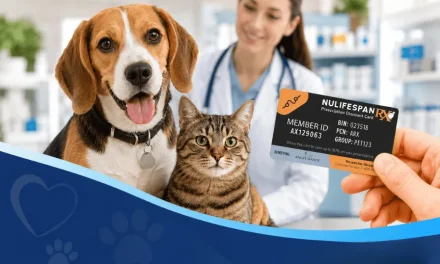
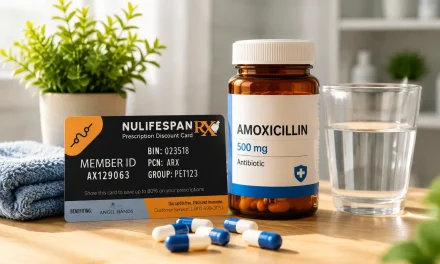
The NuLifeSpan Rx prescription discount card gives you one of the three prices you need. It is free, requires no sign-up for the generic version, never expires, and is accepted at more than 35,000 participating pharmacies nationwide, including major chains and thousands of independents. Discounts of up to 80% are available on eligible prescriptions, and it covers pet prescriptions filled at a retail pharmacy as well as your own.
Two things are worth being straightforward about.
It is not health insurance. It is a discount applied at the counter, it cannot be combined with insurance on the same transaction, and purchases made with it do not count toward insurance or Medicare deductibles or out-of-pocket maximums.
It will not be the lowest price every time. The program applies whichever is less, the pharmacy’s usual price or the negotiated rate, and it does not guarantee the lowest price available anywhere, including against GoodRx, SingleCare or ScriptSave WellRx on any given drug. That is precisely why it belongs in a comparison rather than replacing one. Prices change without notice, so confirm the final amount with the pharmacy before you fill.
If you register for a personalized card rather than using the generic one, eligible transactions also earn $1.50 cashback, paid out monthly once your balance passes $25.
NuLifeSpan Rx supports Little Angel Hands, a nonprofit organization working to improve the lives of children and their families.
Get your free NuLifeSpan Rx card, then use the pricing tool to check what your prescription costs at pharmacies near you.
Final Takeaway
Stop looking for the cheapest pharmacy and start looking for the cheapest price on the specific prescription in your hand.
Write down the drug, strength, quantity and form. Call or search three or four pharmacies of different types, including at least one online option if the medication is one you take long term. For each one, get the cash price and the discount card price, checking more than one card program if the drug is expensive, and compare both against your insurance copay if you have coverage. Ask your pharmacist about a generic and about quantity while you are there. Confirm the final number before it is rung up.
Ten minutes, once per medication. If you take several, the same approach applied across your whole monthly prescription bill is where the meaningful difference shows up.
Frequently Asked Questions
Which pharmacy is the cheapest?
There is no pharmacy that is cheapest for every medication. Independent and warehouse club pharmacies are often competitive on common generics, mail-order tends to win on long-term prescriptions, and national chains vary by location within the same brand. The only reliable answer for your prescription comes from comparing your exact drug, strength, quantity and form at several pharmacies in your area.
How do I compare prescription prices at different pharmacies?
Gather the drug name, strength, quantity, dosage form and your ZIP code, then contact three or four pharmacies of different types or check them through an online pricing tool. For each, ask for the cash price and the price with a discount card applied, and compare both against your insurance copay. Confirm the final amount at the counter before filling, since quoted prices can change.
What is the cheapest pharmacy without insurance?
It depends on the medication. Without insurance you are paying a cash price, and cash prices are exactly where the variation between pharmacies is widest, so comparison matters more, not less. A free discount card frequently reduces the cash price on common generics. If affordability rather than comparison is the real issue, there are additional options for paying for prescriptions without insurance.
Is CVS or Walgreens cheaper for prescriptions?
Neither is reliably cheaper across the board. Pricing at both varies by drug and by location, and each runs its own in-house savings program alongside third-party discount cards, so a generic that is inexpensive at one chain can cost more at the other while a different drug flips the ranking. The comparison method in this guide applies the same way regardless of which two chains you are weighing.
Which pharmacy chains offer the best discounts and promotions?
Most national chains and supermarket pharmacies run some form of in-house savings program, and third-party discount cards like NuLifeSpan Rx, GoodRx, SingleCare and ScriptSave WellRx are accepted at most of them. None of these consistently beats the others on every drug, so the practical approach is to check the store program and at least one discount card against your specific prescription rather than picking a chain based on advertised promotions alone.
Are online pharmacies cheaper than local ones?
Sometimes, particularly for medications taken every month, where lower overhead and 90-day supplies can reduce the per-day cost. They are less useful for a short course you need today. Compare the delivered total, including any shipping, against local quotes, and confirm the pharmacy is licensed in your state and requires a valid prescription.
Can I use a discount card and my insurance at the same time?
No. Pharmacies process one or the other per transaction. Ask the pharmacist to check both prices before the claim is run, then choose. Keep in mind that a discount card purchase generally does not count toward your deductible or out-of-pocket maximum.
Do pharmacy prices change over time?
Yes, and often. Acquisition costs, negotiated rates and retail pricing all shift, so a comparison from several months ago may no longer hold. Re-checking when you start a new medication, and periodically on long-term ones, is worth the few minutes.
Is it safe to switch pharmacies to get a lower price?
It is safe, but there is a trade-off worth knowing. A single pharmacy holds a complete record of what you take, which helps a pharmacist catch duplicate therapies and interactions. If you take several medications and the saving on one is small, staying put may be the better decision. If you do switch, tell the new pharmacist about everything else you are taking.




Trackbacks/Pingbacks