
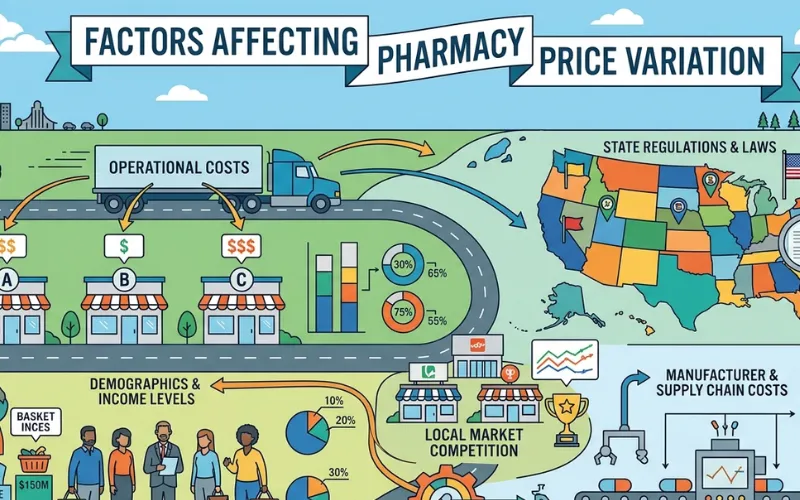
Walmart pharmacy prices vary because each prescription reflects drug acquisition costs, generic competition, state pricing rules, and Walmart’s own markup and dispensing expenses. Insurance contracts and pharmacy benefit manager (PBM) reimbursements also change what patients pay versus Walmart’s cash or $4 generic prices. Shortages, dose strength, quantity, and whether a patient uses insurance or a prescription discount program like NuLifeSpan Rx can further shift costs. Understanding these pricing drivers helps patients anticipate charges and find opportunities to lower out-of-pocket spending.
Key Takeaways
- Insurance design, PBM negotiations, and whether you use cash, insurance, or discount cards all cause the same prescription to price out differently.
- Walmart’s $4 generics only apply to specific drugs, strengths, and quantities; other versions or brands are priced using different rules.
- Drug supply and demand issues, such as manufacturing shortages or limited generic competition, raise Walmart’s acquisition costs and lead to higher shelf prices.
- State regulations, local market conditions, and Walmart’s contracts with wholesalers and PBMs create location-specific price differences for the same medication.
- Pharmacy benefit managers sit between insurers, manufacturers, and pharmacies, and their reimbursement contracts are one of the biggest hidden drivers of what you pay at the counter.
- Walmart isn’t always the cheapest option; CVS, Walgreens, Costco, and independent pharmacies can beat Walmart’s price on specific drugs, so comparing before you fill matters.
- Pharmacy operational costs, including labor and dispensing fees, are built into Walmart’s markup structure, affecting final prices at the counter.
- Free prescription discount programs, such as the NuLifeSpan Rx card, can help patients save up to 80% at over 35,000 participating pharmacies, including Walmart locations.
Why Walmart Drug Prices Vary

Although Walmart promotes simple, low-cost options like its $4 generics, its actual prescription prices vary due to program design, state-level factors, supply constraints, and payer rules.
Walmart’s touted $4 generics mask complex, variable pricing shaped by program limits, states, supply, and insurers
The $4 program applies only to a defined list of generic medications, specific strengths, and quantities, with prorated pricing between 30- and 90-day supplies. When a drug, strength, or package size falls outside these parameters, the prescription reverts to standard retail pricing. Walmart pharmacies also support specialty medications for chronic and complex conditions, which typically fall outside flat-fee programs and can carry higher, more variable prices.
Drug availability further drives variation. Coverage is limited to certain manufacturers and prepackaged unit sizes; if equivalent quantities require multiple units or non-preferred manufacturers, patients may see higher charges.
State-level adjustments, determined by local Walmart pharmacies, can increase list prices for covered generics in specific jurisdictions.
Cash vs. insurance dynamics also affect pricing transparency. Walmart sets usual and customary cash prices relatively high, while insurers reimburse based on contracted rates, maximum allowable cost schedules, and payer-specific rules. This is where a free tool like the NuLifeSpan Rx prescription discount card becomes valuable, it provides a third pricing pathway that can sometimes beat both cash and insured prices at the pharmacy counter.
Main Factors That Change Your Walmart Price
When a patient fills a prescription at Walmart, the final price reflects interacting factors including insurance coverage, current drug supply and demand conditions, dosage strength, quantity dispensed, and state or local rules. Insurance benefit designs, PBM discounts, and real-time coverage determinations drive copays and out-of-pocket costs, so identical prescriptions don’t always generate identical prices. Customers can also use the Walmart app to see estimated prescription prices for refills on all individuals linked to their verified pharmacy account before going to the store.
Medication availability also matters. Manufacturing shortages, constrained wholesalers, or limited in-stock generics shift acquisition costs and can move a drug on or off Walmart’s low-cost lists, challenging pricing transparency for patients comparing options. In these situations, comparing prices across all available pharmacies, a feature built into the NuLifeSpan Rx pricing tool, which searches over 35,000 pharmacies nationwide, can reveal significantly cheaper options nearby.
| Factor | Clinical Impact on Price | Example Scenario |
|---|---|---|
| Insurance Coverage | Alters copay and reimbursement | Plan changes tier; copay increases |
| Medication Availability | Shortages raise acquisition cost | Preferred generic on backorder |
| Dosage Strength | Higher potency increases unit price | 40 mg costlier than 10 mg tablet |
| Quantity Supplied | Total cost changes with days’ supply | 90-day fill cheaper per day than 30-day |
| Location Regulations | State rules modify program eligibility and fees | $4 pricing differs between CA and MN |
| Discount Card Use | Third-party discount can undercut cash and insured prices | NuLifeSpan Rx card saves patient more than plan copay |
How Pharmacy Markups Affect Walmart Pharmacy Prices
Beyond insurance design and supply conditions, Walmart’s own pharmacy markup structure also shapes a patient’s final price at the counter. Its markup strategies must absorb elevated labor costs while preserving a low-cost brand position.
Pharmacy technicians earn an average of $22 per hour and up to $40.50, and operations team leads average $28 with a $42 ceiling. These wages, plus benefits and bonus potential, are embedded in dispensing fees and overhead allocations applied to each prescription. With 4,711 locations nationwide, Walmart’s broad footprint enables these wage and overhead structures to be spread across diverse markets and patient populations.
Because Walmart’s pay scales exceed many competitors and national medians, its markups must fund advanced services, expanded delivery, immunizations, and chronic care management, without making medications cost-prohibitive.
The company distributes these labor costs across a large prescription volume, which can moderate per-prescription markups. For patients, pricing transparency becomes critical: understanding that a portion of the pharmacy charge reflects clinical staffing, customer service, and operational support clarifies why two pharmacies may price the same drug differently and why checking prices across multiple pharmacies before filling is always worthwhile.
How Generic Drug Makers Impact What You Pay at Walmart
As more generic manufacturers enter the market for a given drug, they drive down acquisition costs that ultimately shape what Walmart charges at the pharmacy counter. FDA data show that initial generic entry typically undercuts the brand, and additional entrants intensify generic competition effects, steepening price declines. Because only about 36% of a drug’s retail price reflects actual manufacturing cost, the remaining margin is shaped by distribution, PBM negotiations, and retail markup, all of which interact with generic competition to set the final shelf price.
For patients managing chronic conditions, these dynamics reinforce the value of using every available cost-control tool. The NuLifeSpan Rx discount card, for example, is accepted at Walmart and thousands of other pharmacies and can deliver discounts of up to 80% on generic medications, often well below even Walmart’s advertised $4 price for drugs that fall outside that program’s eligible list.
The Role of Pharmacy Benefit Managers (PBMs) in Setting Your Price
Pharmacy benefit managers show up throughout this article because they sit at the center of the pricing chain. A PBM is the intermediary that negotiates on behalf of insurers and employers with drug manufacturers, wholesalers, and pharmacies like Walmart, and its contracts largely determine what a patient actually pays at the register, regardless of what the sticker price at the counter suggests.
A small number of national PBMs manage prescription benefits for most insured patients in the United States. These organizations build formularies (the lists of covered drugs and their copay tiers), negotiate manufacturer rebates, and set maximum allowable cost (MAC) schedules that determine how much Walmart is reimbursed for a given generic. When a MAC rate sits below Walmart’s own acquisition cost, the pharmacy absorbs the difference on that fill, which is part of why cash or discount-card pricing can sometimes beat an insured copay.
PBM economics also explain why the same medication can carry different copays across insurance plans even at the exact same Walmart location. Rebates negotiated with manufacturers are not always passed directly to the patient at the point of sale, so a drug with a large rebate can still carry a high copay if the plan’s formulary places it on a higher tier. This is one reason pharmacists and patients routinely compare the PBM-adjudicated price against Walmart’s cash price and a free discount card like NuLifeSpan Rx before deciding how to run a prescription.
PBM pricing practices have drawn scrutiny from state insurance commissioners and federal regulators in recent years, particularly around rebate transparency and reimbursement to independent pharmacies. For patients, the practical takeaway is simpler: because PBM contracts change what you owe more than the underlying drug cost does, checking multiple payment pathways, insurance, cash, and discount card, before every fill remains the most reliable way to control what you pay at Walmart.
How Insurance Rules and Payment Method Skew Walmart Prices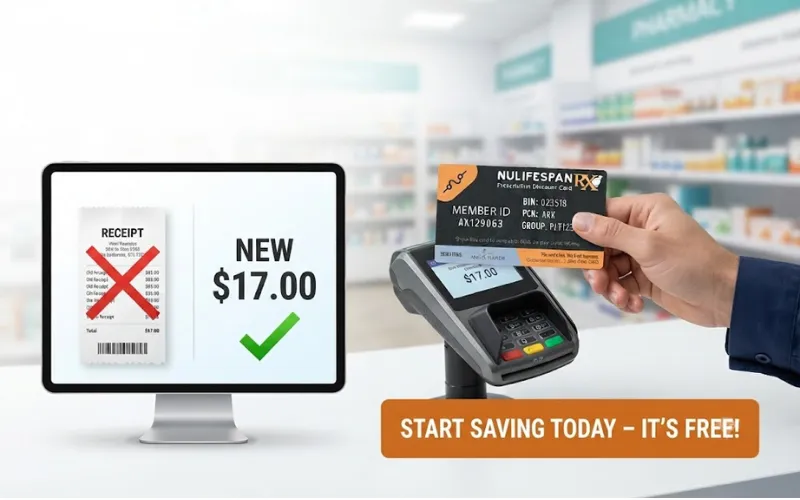
Insurance reimbursement rules can cause the amount a patient pays at Walmart to differ sharply from the pharmacy’s own cash or discount price for the same medication.
Plan design features such as tiered copays, deductibles, and formulary status may result in an insured patient paying more than Walmart’s $4 generic rate or less than the usual cash price, depending on the drug and benefit structure.
Understanding when to use insurance versus Walmart’s cash or a discount program is consequently critical for minimizing out-of-pocket costs while maintaining clinically appropriate therapy. Importantly, the NuLifeSpan Rx card is not insurance, it is a free discount program that works alongside or in place of insurance wherever a lower price can be found.
Insurance Reimbursement Rules
While Walmart’s base cash prices often look straightforward, plan design and reimbursement rules can dramatically change what a patient actually pays at the register.
Pharmacy charges depend on insurance networks, formulary tiering, and deductible status, then flow through complex reimbursement claims processes, especially when Walmart is out-of-network for the plan.
Out-of-network use often triggers higher member liability than the shelf price suggests. Patients may owe both in-network cost share and additional coinsurance, plus any amount above the plan’s allowable charge.
To secure reimbursement, they must meet strict documentation standards, including:
- Original itemized receipt with NDC and Rx number
- Date filled and ingredient cost breakdown
- Prescriber name and pharmacy contact details
- Explanation of Benefits for coordination of benefits
- Submission within the one-year filing limit
Cash Versus Discount Pricing
Cash, discount-card, and insurance billing pathways can all produce different out-of-pocket prices for the same prescription at Walmart, even on the same day.
Walmart’s cash pricing through its $4 list frequently undercuts insurance copays, particularly for chronic generics such as lisinopril, metformin, or atorvastatin, and can yield $300–$600 in annual savings for maintenance therapies.
Third-party discount programs, including NuLifeSpan Rx, may drive prices below Walmart’s list for selected medications. Unlike some discount tools, NuLifeSpan Rx is a free program run by a nonprofit organization dedicated to improving the lives of children and their families, with no membership fees, no sign-up fees, and no eligibility requirements. It works at over 35,000 pharmacies across the country and cannot be combined with insurance billing at the time of purchase, but it is often the better option when a plan copay exceeds the discounted rate.
Patients in Medicare plans, including those in the donut hole, often obtain lower costs with cash or discount cards than with formulary copays, so pharmacists routinely compare all three payment routes before adjudication. Using the NuLifeSpan Rx card in this scenario does not affect Medicare benefit accumulation, purchases made at the discounted price do not count toward the donut hole or out-of-pocket maximums, which can itself represent an advantage for certain patients.
How Walmart Pharmacy Prices Compare to CVS, Walgreens, and Costco
Walmart is one of the largest pharmacy chains in the country, but it isn’t the only retailer competing for prescription business, and it isn’t always the cheapest. CVS, Walgreens, Costco, grocery-store pharmacies, and independent pharmacies each negotiate their own wholesaler and PBM contracts, so the same generic can carry a different cash price depending on which chain fills it.
Walmart’s advantage tends to come from scale: its $4 generic list and large purchasing volume keep a defined set of common medications inexpensive without requiring a membership. Costco, by contrast, does not require a membership to use its pharmacy in most states and is often competitive on both generic and brand-name drugs, though its locations are far less widespread than Walmart’s. CVS and Walgreens typically carry higher base cash prices on many generics but offer denser store networks, loyalty-linked savings programs, and broader clinical services such as immunizations and minor-illness visits.
Price is only part of the comparison. In-store customer service, wait times, drive-through and delivery options, and whether a location carries a specific manufacturer’s version of a drug all factor into where patients ultimately choose to fill a prescription. A pharmacy that is a few dollars cheaper on paper isn’t necessarily the better choice if it means a longer wait or an inconvenient location.
Because no single chain is consistently the cheapest for every drug, the most reliable approach is to compare in real time rather than assume Walmart automatically wins on price. The NuLifeSpan Rx pricing tool checks more than 35,000 pharmacies nationwide, including Walmart, CVS, Walgreens, Costco, and independent locations, so patients can see which retailer actually has the lowest price for their specific medication before they drive anywhere.
How to Compare Walmart Pharmacy Prices and Pay Less

Several practical tools and programs let patients compare Walmart pharmacy prices in real time and minimize out-of-pocket costs.
Effective price checking starts in the Walmart app, where verified users see estimated refill prices based on the last paid claim, then confirm any change at pickup or by phone for shipped refills.
Because medication availability, insurance fluctuations, and local market variations affect totals, patients should systematically compare cash prices, discount programs, and insurance copays. The free NuLifeSpan Rx pricing tool is a practical starting point, it searches real-time prices across more than 35,000 pharmacies, including Walmart, so patients can immediately see whether a nearby CVS, Walgreens, Costco, or independent pharmacy offers a better rate before leaving the house.
Key cost-control tactics include:
- Use Walmart’s $4 list and consider online transfers to move eligible generics.
- Use the NuLifeSpan Rx discount card, it’s free to download, requires no sign-up, and can be added to your Apple or Google wallet or printed at home.
- Compare prices across pharmacy chains using NuLifeSpan Rx’s pricing tool before filling, particularly for brand-name or specialty medications where location-to-location variation can exceed $100 for the same drug.
- Reassess refill strategies (30- vs. 90-day supplies) to reduce per-dose cost.
- For Medicare patients in the coverage gap, consider using a discount card like NuLifeSpan Rx instead of the plan benefit to avoid accelerating donut hole accumulation.
- Call the local Walmart Pharmacy to verify state-specific pricing and manufacturer restrictions.
- Share your NuLifeSpan Rx card with family members, the card covers your entire household, including pets, and cardholders earn $1.50 cashback on every eligible transaction.
Frequently Asked Questions
Does Walmart Pharmacy Price Match Competitors or Discount Card Prices Automatically?
Walmart Pharmacy doesn’t automatically perform price matching or honor discount cards. Staff may manually review competitor prices or card rates if patients request it and provide documentation, but policy restricts matches and excludes many third-party discount programs. Patients who want to guarantee a lower price should use a free discount card such as NuLifeSpan Rx and present it at the counter, the discount is applied instantly without any negotiation.
How Do Walmart $4 Generics Compare to Other Discount Pharmacy Programs?
Walmart $4 generics offer straightforward pricing without enrollment, but they’re limited in drug list and dosages. Discount programs like NuLifeSpan Rx often provide broader formulary coverage and can undercut the $4 price for drugs that fall outside Walmart’s approved list, without restricting patients to a single retailer.
Can I Get a Written Estimate of My Walmart Prescription Cost Before Filling?
Walmart can’t usually provide a formal written estimate, but the app displays prescription cost projections. For a faster cross-pharmacy comparison, patients can use the NuLifeSpan Rx pricing tool, which shows real-time prices at nearby pharmacies before any commitment is made.
Why Do Walmart Pharmacists Sometimes Substitute a Different Generic Than Last Time?
Walmart pharmacists sometimes substitute a different generic because generic variations depend on manufacturer contracts, inventory, and program-eligible stock. Using pharmacist discretion, they select a therapeutically equivalent product that meets formulary, dosage, and availability requirements while maintaining FDA-rated bioequivalence.
How Can I File a Complaint or Appeal About a Walmart Prescription Price?
The patient initiates the complaint process by requesting a pharmacy appeal form, submitting it within 7 business days with Rx, NDC, and acquisition-cost proof. They may escalate unresolved pricing transparency concerns to their insurer or state insurance commissioner.
Who Regulates Walmart Pharmacy Pricing?
No single body sets Walmart’s pharmacy prices. State boards of pharmacy oversee dispensing practices and licensing, state insurance commissioners handle complaints tied to insured claims, and federal regulators, including the FTC, have increased scrutiny of PBM contracting practices that influence reimbursement. Manufacturer pricing itself is largely unregulated at the federal level, which is part of why cash, insurance, and discount-card prices for the same drug can differ so widely.
Is NuLifeSpan Rx Accepted at Walmart Pharmacy?
Yes. The NuLifeSpan Rx discount card is accepted at over 35,000 pharmacies nationwide, including Walmart locations. Simply present your card or show the digital version on your phone at the pharmacy counter to have the discount applied instantly. The card is completely free, requires no insurance, and can be used alongside or instead of your existing coverage whenever it offers a better price.
Conclusion
To sum up, Walmart pharmacy prices vary because of complex, interacting forces: pharmacy markups, generic manufacturers’ pricing, wholesaler contracts, PBM reimbursement terms, competition from other pharmacy chains, and insurance benefit design. These dynamics create substantial differences between cash, discount card, and insured prices for the same medication. Patients who routinely verify Walmart prices, compare them with alternative pharmacies, and discuss lower-cost formulary or generic options with their prescriber are more likely to minimize out-of-pocket prescription drug costs.
One of the simplest steps any patient can take is downloading a free prescription discount card. The NuLifeSpan Rx card, offered at no cost by a nonprofit dedicated to improving healthcare access for children and families, provides instant savings of up to 80% at over 35,000 pharmacies, including Walmart. There are no fees, no eligibility requirements, and no insurance needed. Present it every time you fill a prescription, use the built-in pricing tool to find the best rate in your area, and earn cashback rewards on eligible purchases for yourself and your family.








Trackbacks/Pingbacks