The good news for anyone paying cash for Parkinson’s treatment is that the most important medication, generic carbidopa-levodopa, is one of the more affordable chronic prescriptions in the United States. The harder news is that Parkinson’s regimens rarely stay simple. Doses climb, adjunct medications get added, and some newer brand-name formulations cost hundreds or even thousands of dollars per month. If you are facing Parkinson’s disease medication costs without insurance, comparing pharmacy prices before every fill matters, and a free tool like the NuLifeSpanRx pricing tool shows discounted cash prices at pharmacies near you in seconds.
This article walks through the main Parkinson’s medication classes, realistic cash price ranges, why costs vary and tend to grow over time, and how to reduce what you pay.

Why Medication Is Central to Parkinson’s Care
Parkinson’s disease is a progressive neurological condition in which the brain gradually loses dopamine-producing cells, leading to tremor, stiffness, slowness of movement, and balance problems. The National Institute of Neurological Disorders and Stroke notes that while there is no cure, medications can substantially improve symptoms, and most people take them long term.
Parkinson’s regimens change more than almost any other chronic-condition regimen. What works in year one is often adjusted by year three as symptoms progress, response fluctuates, or side effects appear. Your neurologist may raise doses, split them across more times per day, switch formulations, or add a second or third medication. Each of those changes affects your monthly cost, which is why prices in this article are ranges rather than fixed numbers. Your healthcare professional determines which treatment is appropriate based on your symptoms, disease stage, other medications, and treatment response.
Common Parkinson’s Medications and Estimated Cash Prices

The figures below are approximate cash ranges without insurance, based on published pricing data from sources such as GoodRx, SingleCare, Drugs.com, and pharmacy savings guides reviewed in August 2026. Actual prices depend on dosage, quantity, formulation, pharmacy, location, and available discounts, and they change over time.
| Medication | Generic/Brand | Medication Type | Typical Cash Price Range (30 days) | Important Cost Notes |
| Carbidopa/levodopa IR | Generic (brand: Sinemet) | Dopamine replacement | Roughly $10 to $85 (generic), depending on quantity | The backbone of most regimens. Discounted prices are often under $20 even for 90 tablets. |
| Carbidopa/levodopa ER | Generic (brand: Sinemet CR, discontinued) | Dopamine replacement, extended-release | Roughly $30 to $160 (generic) | ER tablets cost more than IR. Never split ER tablets unless instructed. |
| Rytary / Crexont | Brand only | Extended-release capsules | Often several hundred dollars or more (brand) | No generic equivalents. Manufacturer savings programs exist for some patients. |
| Pramipexole | Generic (brand: Mirapex) | Dopamine agonist | Roughly $15 to $200 (generic) at retail; discounts often bring it under $20 | ER version prices much higher at retail, near $480 at some pharmacies. |
| Ropinirole | Generic (brand Requip discontinued) | Dopamine agonist | Roughly $15 to $95 (generic) | IR tablets are inexpensive; ER tablets cost more. |
| Rotigotine | Brand only (Neupro patch) | Dopamine agonist, transdermal | Typically several hundred dollars (brand) | Patch formulation with no generic; among the pricier options. |
| Rasagiline | Generic (brand: Azilect) | MAO-B inhibitor | Varies widely by pharmacy; discounted prices are often modest | Generic competition has lowered prices substantially versus the old brand. |
| Selegiline | Generic | MAO-B inhibitor | Generally low-cost generic; prices vary | Capsules are usually cheaper than orally disintegrating forms. |
| Entacapone / combination tablets | Generic (brands: Comtan, Stalevo) | COMT inhibitor | Roughly $100 to $300 (generic combo tablets) | Adds meaningful cost on top of a base regimen. |
| Opicapone | Brand only (Ongentys) | COMT inhibitor | Typically very expensive without coverage (brand) | Newer once-daily option with no generic. |
| Amantadine IR | Generic | Antiviral used for dyskinesia/symptoms | Roughly $15 to $50 (generic) | Brand extended-release versions such as Gocovri cost dramatically more. |
Anticholinergic medications such as trihexyphenidyl are also inexpensive generics used in select younger patients, though they are prescribed less often today. Not every medication in this table is appropriate for every person with Parkinson’s, and combinations are common. Check whether your specific prescription is eligible for discounts on the NuLifeSpanRx covered drugs page.
Why Parkinson’s Medication Prices Vary Without Insurance
Generic vs brand formulation. Generic carbidopa/levodopa IR can cost under $20 per month, while brand extended-release capsules of the very same active ingredients can cost hundreds. Same molecule, very different delivery technology and patent status.
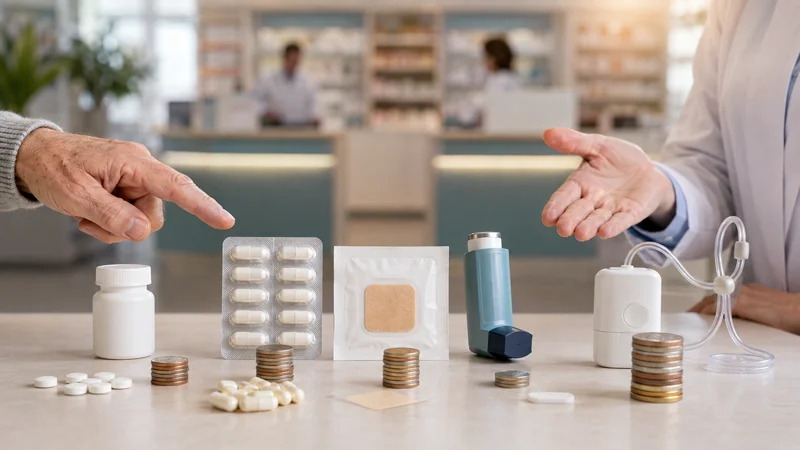
Formulation and delivery method. Tablets, extended-release capsules, patches, inhalers, and pump-delivered gels (such as Duopa) sit at completely different price levels. Transdermal and device-based options are consistently the most expensive.
Dose frequency and quantity. Parkinson’s dosing often means three, four, or more doses per day. A prescription for 90 tablets prices very differently from one for 270 tablets, even though the per-tablet cost may drop at higher quantities.
Pharmacy pricing. Cash prices for the same generic vary widely between pharmacies in the same area. Published comparisons regularly show gaps of $30 or more per month on common Parkinson’s generics, and far larger gaps on adjunct drugs.
Location and supply. Regional wholesale pricing and periodic shortages of carbidopa-levodopa formulations can push prices up temporarily and make comparison shopping even more valuable.
Combination regimens. Adding a COMT inhibitor or dopamine agonist to a levodopa base multiplies the monthly total. The regimen, not any single drug, is your real cost.
The NuLifeSpanRx guide on finding the cheapest pharmacy for any medication explains how to compare local prices efficiently.
Generic vs Brand-Name Costs
Nearly every core Parkinson’s medication has an affordable generic: carbidopa/levodopa, pramipexole, ropinirole, rasagiline, selegiline, entacapone, and amantadine. FDA-approved generics contain the same active ingredients at the same strength as the brand and are the default choice at most pharmacies.
The main exceptions are newer delivery formats, including Rytary, Crexont, the Neupro patch, Ongentys, Gocovri, and Duopa, which have no generic equivalents. These can be clinically valuable, particularly for motor fluctuations, so if one has been recommended and the price is out of reach, talk with your neurologist about alternatives or manufacturer assistance rather than abandoning the plan. Do not change or stop any Parkinson’s medication on your own, because sudden changes can significantly worsen symptoms.
Monthly and Long-Term Cost Planning
Parkinson’s is a long-term condition, and medication needs typically grow. A realistic budget accounts for three patterns:
- Dose escalation. Levodopa doses and dosing frequency commonly increase over the years, which raises quantity per fill even when the per-tablet price stays flat.
- Added medications. Many patients eventually take a levodopa base plus one or two adjuncts. Each addition is a new monthly line item.
- Formulation changes. A move from IR tablets to an extended-release or brand formulation to smooth out symptom fluctuations can raise costs sharply, which is worth discussing openly with your prescriber when it happens.
Because of these moving parts, avoid locking in an assumed annual cost. Instead, reprice your full regimen at each change and at least every few refills. Small per-fill differences compound over years of daily, multi-dose treatment.
How to Lower Parkinson’s Medication Costs Without Insurance
- Confirm you are on generics wherever appropriate. For carbidopa/levodopa and most adjuncts, generics are the standard of care and cost a fraction of brand pricing.
- Compare pharmacy prices before every fill. Include independents and warehouse pharmacies, which are often cheaper than large chains for cash payers.
- Use a free prescription discount card. Discounted rates on Parkinson’s generics are frequently a small fraction of retail cash prices.
- Ask about 90-day fills. For stable maintenance medications, larger quantities usually lower the per-dose price.
- Ask your neurologist about lower-cost clinically suitable options. If a brand formulation is unaffordable, there may be a workable generic-based alternative regimen.
- Investigate assistance programs. Manufacturer programs cover some brand formulations, and organizations such as the Parkinson’s Foundation and PAN Foundation help patients navigate financial support.
- Ask the pharmacist about formulation pricing. Tablet strength combinations and IR vs ER choices can change the price. Any adjustment must come from your prescriber.
Never stretch doses, skip days, or split extended-release tablets to save money. With Parkinson’s medications, timing and consistency directly affect how well you function each day.
How NuLifeSpanRx May Help With Prescription Costs
NuLifeSpanRx provides a free prescription discount program accepted at more than 35,000 pharmacies across the United States. It is not insurance and it does not guarantee a specific price, but it applies pre-negotiated discounted rates to eligible prescriptions, which is often meaningful for cash payers filling Parkinson’s generics month after month.

To use it, look up your exact prescription in the pricing tool to see which nearby pharmacy has the lowest discounted price, then download a free card from My Cards and show it at the counter with every fill. The card is free, never expires, and can be used by your whole family. Seniors who have hit coverage limits and patients whose plans exclude a specific drug can also use the program instead of insurance on those fills; see the NuLifeSpanRx underinsured resource for details.
Frequently Asked Questions
How much does carbidopa-levodopa cost without insurance?
Generic immediate-release carbidopa/levodopa often costs roughly $10 to $85 per month in cash depending on quantity and pharmacy, and discounted prices are frequently under $20. Extended-release generics and brand capsules such as Rytary cost considerably more.
What is the cheapest Parkinson’s medication option?
Generic carbidopa/levodopa immediate-release tablets are usually the most affordable core treatment, and generics like ropinirole, selegiline, and amantadine are also inexpensive. The right regimen is a clinical decision, so raise cost concerns with your neurologist rather than switching on your own.
Why is the same Parkinson’s prescription priced differently at different pharmacies?
Each pharmacy sets its own cash price based on wholesale costs and local competition, so identical prescriptions can differ by $30 or more per month for common generics. Comparing prices before filling, or using a price-comparison tool, prevents overpaying.
Do Parkinson’s medication costs increase over time?
They often do. Doses and dosing frequency tend to rise as the condition progresses, and adjunct medications are frequently added, so the total regimen cost usually grows even when individual drug prices stay stable.
Is the Neupro patch or Rytary covered by discount cards?
Brand-only products may be eligible for discounts at participating pharmacies, but savings on brands are usually smaller than on generics. Manufacturer savings and patient assistance programs are often the better route for brand formulations, so check both options.
Can I use NuLifeSpanRx without health insurance?
Yes. NuLifeSpanRx is a free discount program rather than insurance, so anyone can use it. Savings vary by medication and pharmacy, and the card works at more than 35,000 pharmacies nationwide.
Can my price change between refills?
Yes. Pharmacy cash prices shift with wholesale costs and supply, and any change in your dose, quantity, or formulation changes the price too. Recheck prices before each refill, especially after your prescriber adjusts your regimen.
This article is for general information only and is not medical advice. Decisions about starting, stopping, or changing Parkinson’s medications should always be made with a qualified healthcare professional. Pricing referenced reflects published data available as of August 2026 and is subject to change.