
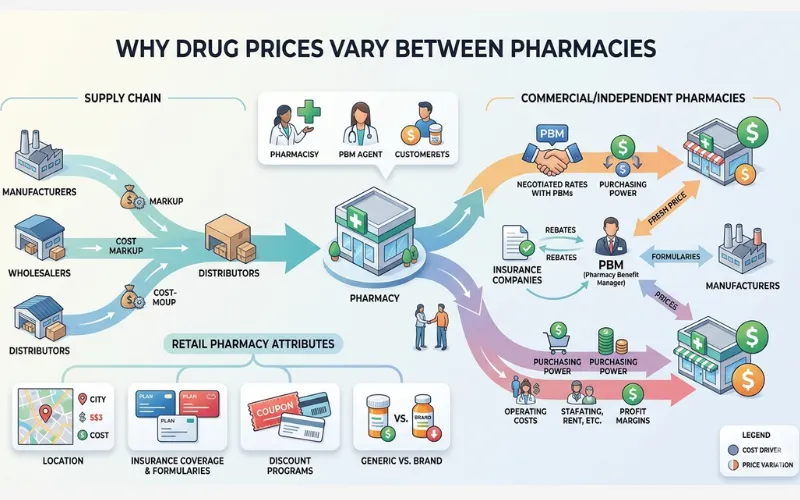
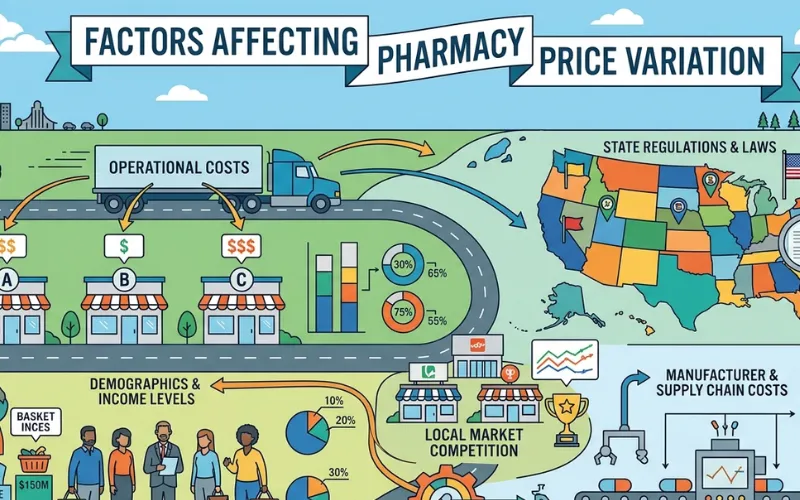
Drug prices differ from one pharmacy to another for a wide range of reasons, from supply chain negotiations to regional markup rules. Understanding the forces behind these disparities helps you find the most affordable option for any medication instead of accepting whatever price you see first.
Price Negotiation Dynamics in the Supply Chain
In drug pricing, understanding supply chain negotiation dynamics is essential. Manufacturers often dominate transactions with ordinary pharmacies, creating an imbalance. This “strong-weak” dynamic means retailers can push for higher profits as their influence grows, but it also leads to higher retail prices. When manufacturers and retailers share balanced power, total supply chain profit tends to maximize.
If one party becomes dominant, the other’s earnings suffer. Channel price competition also means manufacturers may raise wholesale prices to manage online-to-offline sales tension, which affects overall pricing strategies across the board.
Pharmacy Pricing Formulas and Markup Structures
Pharmacy pricing formulas and markup structures determine how medications are priced for consumers. Understanding these formulas can help you make informed decisions about the cost of prescriptions. Here’s an overview:
Average Wholesale Price Basis
The Average Wholesale Price (AWP) forms the backbone of many drug reimbursement contracts between plan sponsors and pharmacy benefit managers (PBMs). AWP is not an actual transaction price but an estimated average of what pharmacies pay wholesalers. PBM contracts often apply an “AWP minus X%” formula to determine reimbursement. AWP typically ranges 20 to 25% above the Wholesale Acquisition Cost (WAC), making WAC a more reliable baseline since it reflects the manufacturer’s list price without intermediary adjustments.
Dispensing Fee Variability
Dispensing fees can range from $0 to $12 and vary based on pharmacy size, location, and prescription volume. State Medicaid fees also range from $1 to $14.01 per prescription. These fees cover operational costs, with the national mean cost of dispensing reaching $12.40 per prescription in 2018. The variability in these fees is one of the clearest explanations for why medication costs can seem so high depending on where you fill a prescription.
Percentage Markup Challenges
Different pricing formulas mean pharmacies apply higher markups on cheaper drugs and lower markups on pricier ones. A cost-plus formula adds operating costs and a desired profit to the drug cost.
| Cost Component | Example Value |
| Drug Cost | $100 |
| Operating Cost | $11.34 |
| Desired Profit | $11.13 |
| Selling Price | $122.47 |
A 175% markup on a $1 generic provides only a 75-cent profit, so this percentage approach does not translate to significant dollar gains on high-cost drugs.
Chain Versus Independent Pharmacy Pricing Patterns
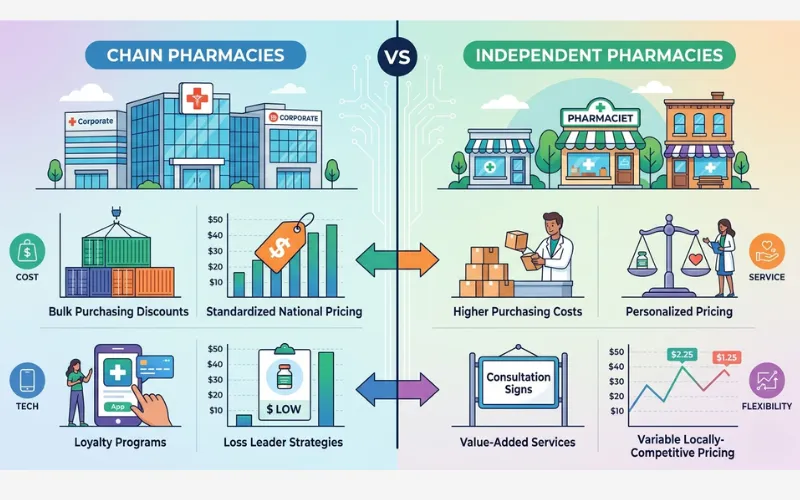
Chain and independent pharmacies often have different pricing strategies due to their operational models. While chain pharmacies benefit from large-scale purchasing and standardized pricing, independent pharmacies may offer more flexibility but often face higher supplier costs. Here’s a comparison of the two pricing patterns:
Price Variability Factors
Independent pharmacies often charge higher prices in lower-income areas, with stark variations for certain drugs. Chain pharmacies maintain more consistent pricing regardless of local income levels. PBM reimbursements considerably favor chains, offering them much higher payments than independents receive. Despite this, independents occasionally offer lower generic prices after negotiation, and cash prices can be competitive when combined with online discount tools.
Service and Pricing Balance
Chains benefit from higher reimbursements and lower wholesale prices, allowing them to offer lower prices in many cases. Independents face higher costs and lower reimbursements but compensate with personalized care and competitive pricing through discount programs. Understanding how savings programs work at major chain pharmacies can help you take full advantage of what each type of pharmacy offers.
Business Models and Competitive Positioning
Independent pharmacies carve out a unique position by focusing on personalized care and community involvement. They are more common in rural areas, where they make up 52% of stores and serve underserved populations. Chain pharmacies leverage economies of scale and expanded PBM negotiating power. Newer online pharmacy models have also entered the market, eliminating certain markups and lowering prices for some consumers.
Impact of Lack of Price Regulation
The lack of price regulation in pharmacies can lead to inconsistent pricing, making medications less affordable for consumers.
Negotiation-Driven Price Discrepancies
The lack of standardized national regulation leads to negotiation-driven discrepancies that significantly affect what you pay. Each province in Canada sets its own markup rules, creating a mosaic of pricing structures. PBMs further complicate matters with unique Maximum Allowable Cost (MAC) lists, requiring pharmacies to navigate multiple reimbursement strategies. Group benefits plans also cap markups, adding another layer of variability to out-of-pocket costs.
Variable Pharmacy Markup Strategies
Pharmacies engage in competition-based pricing, benchmarking against nearby rivals through price matching and adjusted markups. Provinces like Saskatchewan apply markups ranging from 10% to 30% based on drug cost, while Ontario applies 6% on high-cost claims. Price inconsistencies at large chains such as Walmart are also more common than most consumers realize, and why Walmart pharmacy prices vary comes down to many of these same regional and competitive factors.
Complex Supply Chain Dynamics
Without national oversight, multiple forces interact to create price variability across pharmacies.
- Regional Markup Variations: Provinces have different maximum markups, leading to uneven pricing.
- PBM Maximum Allowable Cost Lists: Different lists force pharmacies to juggle multiple pricing structures.
- Wholesaler Markup Practices: No consistent wholesaler regulations mean markups vary at every level.
- Group Benefits Plan Caps: Caps vary across plans, leading to higher out-of-pocket costs when limits are exceeded.
Insurance Coverage and Its Effect on Pricing
As insurers gain bargaining power, they can significantly affect drug pricing through their negotiations. For every 100,000 additional insurer members, prices decrease by roughly 2.5 percent.
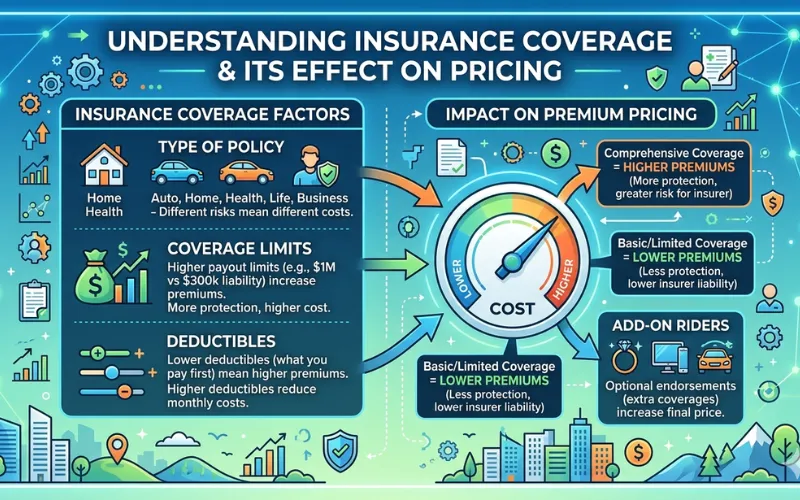
Insurers negotiate rebates with manufacturers for favorable formulary placement, which lowers prices. However, patient cost-sharing often depends on the list price rather than the discounted price, resulting in higher out-of-pocket costs even when substantial rebates exist behind the scenes.
Cash Prices and Discount Card Variability
Cash prices vary widely based on pharmacy type, neighborhood demographics, and discount card usage. Independent pharmacies charge roughly 1.61 times more for generics than large chain pharmacies, while big-box stores tend to offer the lowest prices. Discount cards provide meaningful savings but cannot always counteract rising list prices. If you need to fill prescriptions without insurance coverage, comparing cash prices across multiple pharmacies before filling is one of the most effective strategies available.
Influence of Manufacturing Shortages and Supply Issues
Manufacturing shortages play a critical role in drug price fluctuations. When shortages occur, prices spike, especially in markets where prices were already low and margins thin. With fewer suppliers, remaining manufacturers gain bargaining power and raise prices sharply. Even after a shortage eases, prices rarely fall quickly and continue growing due to supply-demand dynamics. With 90% of active pharmaceutical ingredients produced overseas, a disruption at a single facility can ripple across the entire market.
Generic Drug Market Implications
The generic drug market faces significant challenges driven by buyer concentration and aggressive pricing strategies. Three major buying groups control most purchases, dictating terms and squeezing manufacturers’ margins.
- Race-to-the-Bottom Pricing: Competition erases profit margins, sometimes leaving manufacturers at a loss.
- Market Exits: Many generics are withdrawn or never launched due to poor profitability.
- Patent Cliff Opportunities: Upcoming expirations could create savings, but profitability windows are shrinking.
- Supply Chain Revenue Dynamics: Generics fill the bulk of prescriptions but capture far less revenue, worsening supply pressures.
Factors Affecting Price Variations Across Regions
Brand-name drugs with patent protection and the presence of generic alternatives significantly influence regional costs. In areas with stronger government regulation, pricing is more controlled, as seen in markets with national price-setting authority compared to free-market systems. Large-scale purchasers can negotiate better discounts, further impacting regional prices. High-spending areas tend to use more medications at a higher cost per prescription, compounding the variability consumers experience depending on where they live.
Frequently Asked Questions
How do pharmacists determine the cost of a new drug?
Pharmacists determine the cost of a new drug by calculating acquisition costs, then adding operating expenses and a desired profit margin. Pricing strategies, reimbursement models, and PBM influences all factor into setting a competitive price that aligns with market dynamics and reimbursement structures in place at that pharmacy.
Are there international differences in pharmacy pricing strategies?
Yes, international differences in pharmacy pricing are significant. Countries apply methods including external reference pricing, value-based pricing, and internal reference pricing. These approaches are shaped by factors such as therapeutic value, budget impact, and each country’s regulatory framework, which is why the same drug can cost dramatically different amounts across borders.
What role do pharmacy benefit managers play in drug pricing?
Pharmacy benefit managers (PBMs) negotiate drug prices, rebates, and manage formularies on behalf of insurers. They often retain a portion of rebates negotiated with manufacturers, which can contribute to higher list prices even when net prices are lower. Their practices directly affect what consumers pay out of pocket at the pharmacy counter.
How does government policy influence drug prices?
Government policy influences drug prices by permitting negotiations, setting pricing caps, and requiring rebates from manufacturers. These measures aim to control costs but can also affect drug access and the pace of innovation. The specific policies in place in any given country or region determine how much consumers ultimately pay.
Do pharmacy locations affect drug availability?
Yes, pharmacy location directly affects drug availability. Urban areas typically have more pharmacies with broader inventory and extended hours. Rural locations often have fewer options, limiting access to necessary medications. This geographic gap also contributes to pricing differences, since reduced competition in rural markets gives pharmacies less incentive to lower prices.
Conclusion
Drug prices vary widely between pharmacies because of supply chain negotiations, markup structures, lack of uniform regulation, insurance dynamics, and regional market conditions. As a consumer, comparing prices across pharmacy types and using available discount tools can lead to meaningful savings. NuLifeSpan Rx provides a free prescription discount card that works at thousands of pharmacies nationwide, helping you pay less regardless of where you fill your prescription.










Trackbacks/Pingbacks